1999 Buick Cielo Concept
Explore the 1999 Buick Cielo Concept: sourced history, rarity, specifications, six FAQs and authentic photographs with visible credits.
1999 Buick Cielo Concept brings a documented physical design experiment into Buick’s history. This profile explains its history, specification, production scope and collector significance with named sources and credited photographs.
Record: BUI-134 · Buick · 1999 · Archive.
1999 Buick Cielo Concept: history and background
The Cielo explored an unusual combination: the accommodation of a four-door Buick with an open-air roof concept and a simplified electronic interface. Buick’s retrospective identifies the 1999 Cielo as the show car that brought portholes back into the marque’s concept vocabulary. The name therefore belongs in Buick’s design-development history as well as its convertible story. It was an experimental object, not a normal production Regal trim sold under a second name.
Specifications and production scope
| Item | Documented reference |
|---|---|
| Production scope | Original 1999 physical Cielo show-car identity; the later Regal-based Cielo demonstrator is not a second record here. |
| Reference year | 1999 |
| Factory/model identity | Cielo Concept |
| Body | Four-door open-air concept |
| Engine | Concept powertrain; exact installed configuration is not certified by the selected manufacturer retrospective |
| Manufacturer / reference market | Buick / United States |
| Inventory reference | BUI-134 — Verified |
| Source basis | Named manufacturer, period literature, owner or archive research; source qualifications retained below |
Design and engineering
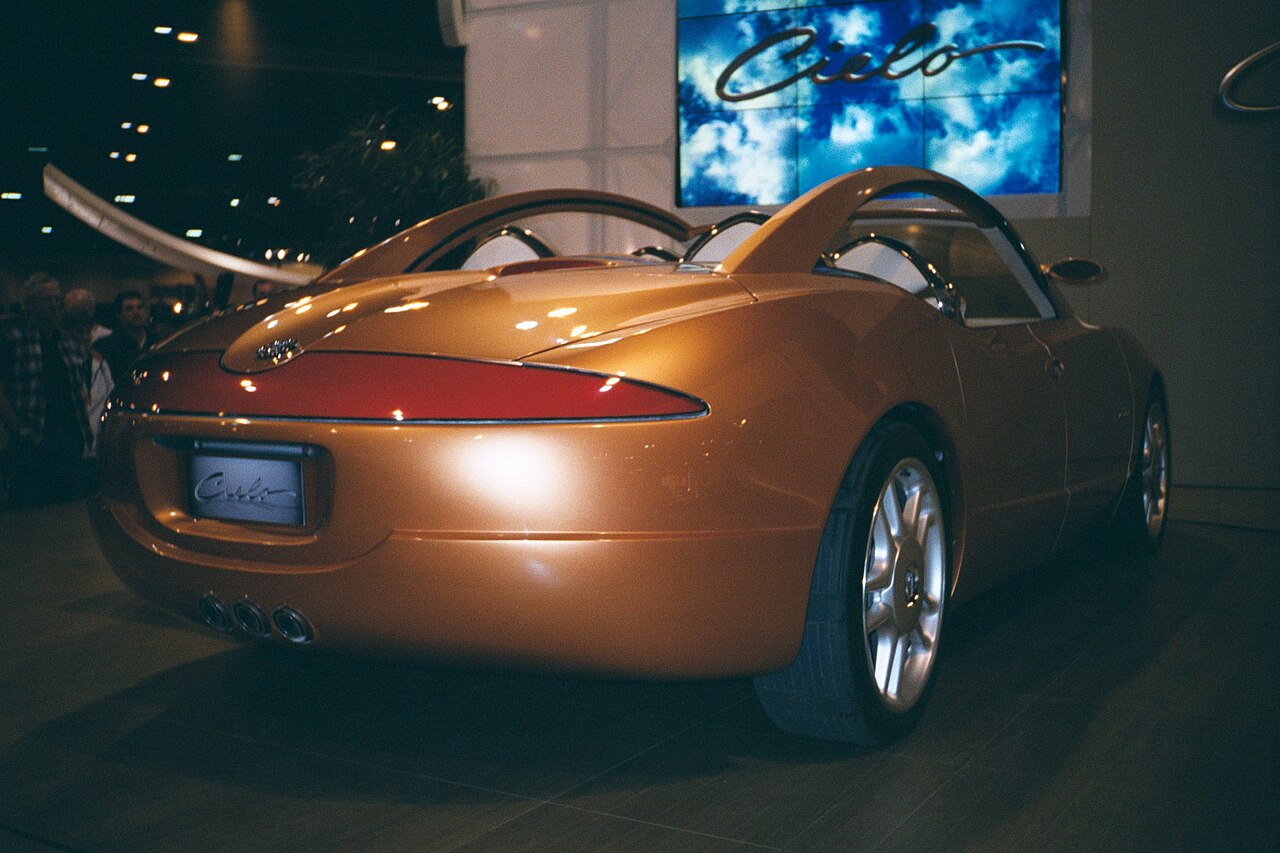
The selected Tampa auto-show photograph shows the original sculptural Cielo study with its roof sections raised. The rounded tail, long cabin and distinctive opening arrangement distinguish it from the later Regal-based demonstrator. Contemporary first-person reporting describes the subsequent effort to apply the roof idea to a more conventional sedan. The two stages should not be collapsed into one fixed mechanical specification or mistaken for two separately qualifying production editions.
Model identity and rarity
This archive keeps the original 1999 concept identity. No retail production count is asserted, and the exact number of development objects across the whole Cielo programme is left unset. The manufacturer’s dated retrospective and the photographer’s model identification establish the historical context. A later exhibition date does not make the pictured design a new model-year car, just as a production-based development vehicle does not automatically replace the original concept in the catalogue.
Collector significance
The Cielo demonstrates how Buick tried to make experimental design useful to a wider audience. Open-air motoring, passenger space and reduced-control interfaces were being considered together. Its value is the documented exploration and the conversation between show-car form and practical development, even where the programme did not produce a retail model. Beside the Bengal, it shows that Buick’s early digital-interface work was applied to very different body shapes rather than confined to one sports-car proposal.
Compare related verified Buick profiles
Read this 1999 Cielo Concept beside the 1995 Buick XP2000 Concept and 2001 Buick Bengal Concept to place its four-door open-air concept in context. The related entries retain their own years, model identities and production scopes, so their figures are not added to this record.
Frequently asked questions
Why is the Cielo dated 1999?
Buick’s own design retrospective identifies the concept as the 1999 Cielo. Later show photographs do not alter its introductory identity.
Is this the later Regal-based Cielo?
The photograph shows the original sculptural show-car design. The later production-based demonstrator is discussed as development context, not an extra profile.
Was Cielo a regular factory convertible edition?
No. It was an experimental open-air concept programme, not a certified customer-production series.
Why is the Cielo Concept included as a rare Buick?
Original 1999 physical Cielo show-car identity; the later Regal-based Cielo demonstrator is not a second record here. The scope is tied to this specific year, body or original project. It does not confer the same rarity on every car carrying the broader Buick Concepts name, and it does not describe how many survive today.
What records help identify an individual Cielo Concept?
Begin with the documented year and four-door open-air concept. Read the original model/body identification and surviving factory or collection records together. Record replacement components and restoration work separately. For a concept or racing car, its physical-car provenance is especially important; for an optioned production model, retain the equipment paperwork.
What photographs and credits accompany this profile?
The bundled photograph is retrieved from named Wikimedia Commons file records. Each image has a visible photographer or archive credit, its own licence link and an accurate subject caption. The pictures illustrate the documented model; they do not establish ownership, present condition or every component’s originality.
Sources and photo credits
Production figures retain the scope and qualifications of the named references. Manufacturer and museum records establish project identity; auction and historical model references supply additional body-specific context.
- Buick — Portholes Are Back, original manufacturer history reproduced by The Auto Channel
- Mark Maynard / Copley — first-person Cielo development drive, contemporary March 2000 report
Photo: Michel Curi / Wikimedia Commons · CC BY 2.0. No local cropping, retouching or content removal. A source-supplied size variant is used where available.
Why this machine matters
The Cielo demonstrates how Buick tried to make experimental design useful to a wider audience. Open-air motoring, passenger space and reduced-control interfaces were being considered together. Its value is the documented exploration and the conversation between show-car form and practical development, even where the programme did not produce a retail model. Beside the Bengal, it shows that Buick’s early digital-interface work was applied to very different body shapes rather than confined to one sports-car proposal.
Built in limited numbers
Original 1999 physical Cielo show-car identity; the later Regal-based Cielo demonstrator is not a second record here.
Gallery
Specifications
Factory specifications may vary by model year, market and configuration.
Identity & production
- Official model
- Cielo Concept
- Base model
- Buick Concepts
Powertrain & performance
- Engine
- Concept powertrain; exact installed configuration is not certified by the selected manufacturer retrospective