1998 Mercedes-Benz CLK-GTR Straßenversion Coupé
Explore the 1998 Mercedes-Benz CLK-GTR Straßenversion Coupé: programme history, design, verified rarity scope, specifications and credited photography.
The Mercedes-Benz CLK-GTR Straßenversion Coupé is a road-going counterpart to an exceptionally focused GT racing project. Its name shares CLK with familiar production coupés, but its low, wide body and mid-engined structure describe a very different vehicle. The original customer coupé series comprised 20 cars in the cited records.
History and verified programme identity
The racing CLK-GTR appeared in 1997. The road customer programme followed, and this profile uses 1998 rather than transferring the racer’s 1997 date to every Straßenversion coupé. RM Sotheby’s programme account identifies a twenty-coupé group within a broader contemporary road-car reference. Petersen’s later custodial summary uses a wider 28-car scope that includes prototypes and six roadsters. The difference is explained instead of forcing every publication into a single number with an unstated definition.
Engineering and design
Petersen describes the road version as closely related to the racer, with a carbon-fibre monocoque and a V12 enlarged to 6.9 litres. Its civilised equipment remained comparatively minimal. This combination helps explain why the road car is more than a styling homage. The underlying arrangement controls the passenger cell, the large volumes behind it and the relationship between door openings and structure. At the same time, a customer road car is not identical to the race car at every point in development. This specification belongs to the documented programme. It should be compared using the original measurement convention and the relevant configuration. A larger number copied from a different engine, market or racing derivative would describe a different car. Likewise, an engine change during restoration does not add another vehicle to the original production run. The distinction matters particularly when a model name appears in both road and competition histories: shared styling or ancestry can coexist with substantially different structures and equipment.
The physical car in the supplied photograph
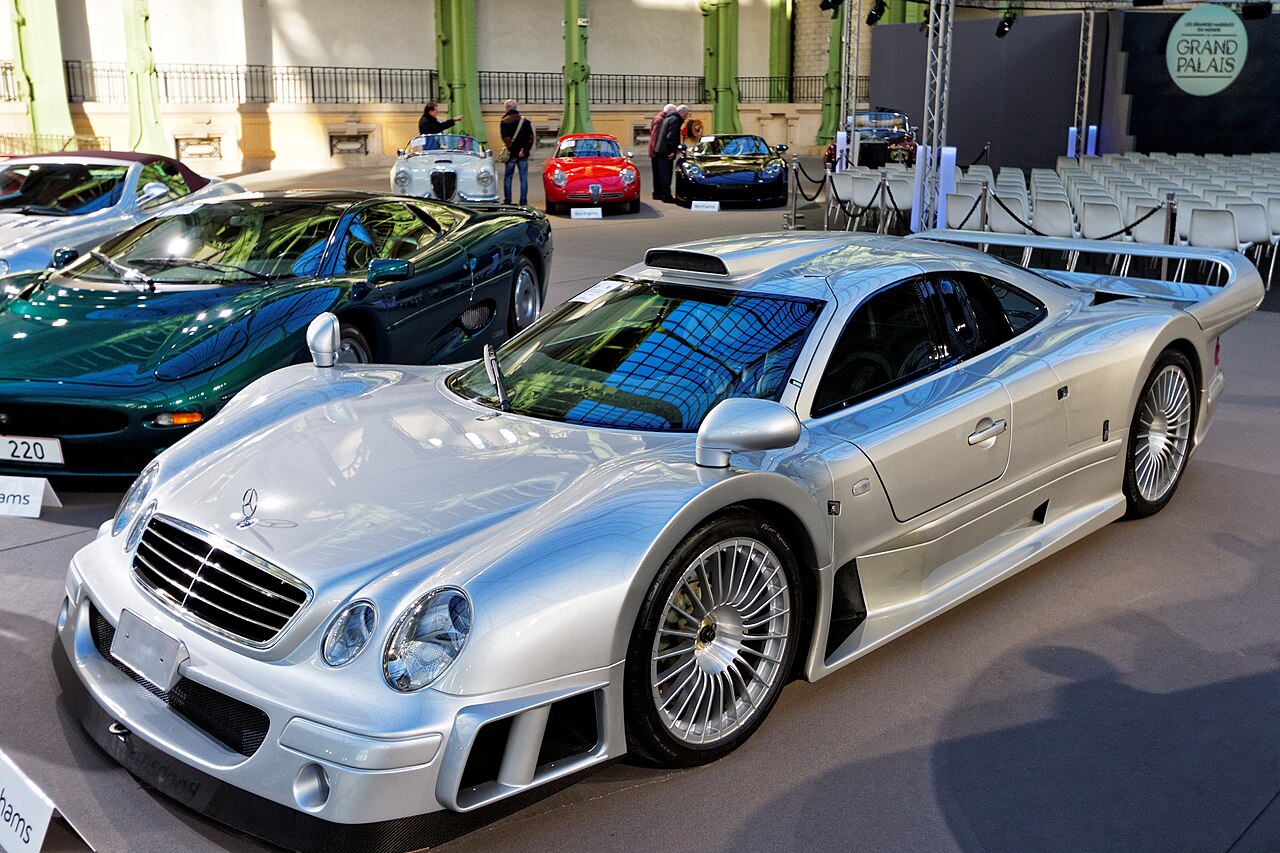
Creator-identified Mercedes-Benz CLK-GTR Straßenversion Coupé at the Bonhams Paris 2016 display, showing the closed roof and large rear wing. The event-file year does not replace the programme reference.
What makes this version distinct
The road coupé should not be confused with a CLK-LM, a competition CLK-GTR or a normal CLK fitted with an aftermarket body. The source photographs include several visually similar racing subjects, so this profile deliberately uses a creator-identified Straßenversion coupé. The original homologation context is part of its story; a regulation’s required quantity and an independently reconciled fabrication tally are different records.
Collecting and chassis evidence
An individual road coupé needs its permanent chassis record, delivery specification and any later engine or body updates. Document unusually specified examples without treating every later update as a new factory series. Racing provenance must be attached to the appropriate chassis, not inferred from a road car’s homologation ancestry. Start with the permanent chassis identity and a dated factory specification, then organise invoices, registration documents and photographs into a chronology. A recent photograph describes present appearance; the original delivery record establishes how the vehicle left its manufacturer. Record replacements and reversible changes without erasing their dates. For a limited edition, retain the allocation paperwork and edition plate together, since a badge alone cannot establish membership. Photographs of body seams, interior fittings and mechanical markings help a specialist understand changes across time. Where a vehicle has been repainted or restored, keep the earlier material alongside the finished appearance. A clearly documented change is more informative than an unsupported claim that every component has remained untouched.
Related Mercedes-Benz designs and meaningful comparisons
The CLK-GTR Roadster shares the broad road programme but changes the upper body and access. C 112 offers an earlier mid-engined research comparison without a corresponding customer production run. Together they clarify how similar visual ambition can lead to very different manufacturing and ownership histories.
Reading the sources
The programme sources and the photograph answer different questions. Manufacturer and custodial records establish the original model, Type, category and published production scope. The creator’s file establishes the pictured subject, setting and image permission. An individual chassis history can then add ownership, competition entries and dated repairs without changing the scope of the original programme. Build references are not survivor counts, and a later specification does not automatically become an additional newly manufactured vehicle. Where primary evidence does not establish a complete fabrication census, that field remains unassigned.
Specifications and rarity evidence
| Programme reference year | 1998 |
|---|---|
| Model / Type | CLK-GTR Straßenversion Coupé — C 297 |
| Body / competition role | Mid-engined homologation road coupé |
| Role | Customer Straßenversion road coupé |
| Engine reference | 6.9-litre V12, road-programme custodial account |
| Structure | Carbon-fibre monocoque, road-programme account |
| Published build / register reference | 20 |
| Separately audited completed tally | Not assigned |
| Count scope | Twenty customer coupés form the original closed road-car series in the cited programme records. Petersen separately describes 28 road-version vehicles including two prototypes, 20 coupés and six roadsters. The profile does not merge prototype or roadster quantities into the customer-coupé count. |
| Manufacturer / archive identity | Mercedes-Benz CLK-GTR Straßenversion Coupé |
Frequently asked questions
How rare is the CLK-GTR Straßenversion Coupé?
Twenty customer coupés form the original closed road-car series in the cited programme records. Petersen separately describes 28 road-version vehicles including two prototypes, 20 coupés and six roadsters. The profile does not merge prototype or roadster quantities into the customer-coupé count.
How is CLK-GTR Straßenversion Coupé classified?
This is a named original Mercedes-Benz road-car programme or factory body configuration within a qualifying low-volume family. The source-defined reference is below 7,500. Completed manufacture, shared allocation ceilings and current survivor counts remain separately labelled.
Which technical details are established for the programme?
The primary record supports role: Customer Straßenversion road coupé; engine reference: 6.9-litre V12, road-programme custodial account; structure: Carbon-fibre monocoque, road-programme account. These are programme or explicitly attributed photo references. A particular surviving car’s engine, chassis repairs and competition preparation require its own dated documentation.
Does the photographed appearance establish factory originality?
The caption records a real creator-identified CLK-GTR Straßenversion Coupé subject and its documented setting. It establishes the illustration’s scope, while original components, restoration work and individual race provenance require chassis-specific evidence. A competition number, current paint or museum display is not used as an originality certificate.
What rarity or archive scope is verified?
Twenty customer coupés form the original closed road-car series in the cited programme records. Petersen separately describes 28 road-version vehicles including two prototypes, 20 coupés and six roadsters. The profile does not merge prototype or roadster quantities into the customer-coupé count.
Who photographed the supplied image?
Thesupermat via Wikimedia Commons, under CC BY-SA 4.0. The original file and licence are linked with the image. Retain the creator, source and licence when uploading, exporting or reusing it; local retouching and synthetic enlargement have not been performed.
Related Mercedes-Benz profiles
Sources and photo credits
Photograph: Thesupermat via Wikimedia Commons original source, CC BY-SA 4.0. Original image or source-provided thumbnail supplied without local cropping, retouching or synthetic enlargement.
Built in limited numbers
Twenty customer coupés form the original closed road-car series in the cited programme records. Petersen separately describes 28 road-version vehicles including two prototypes, 20 coupés and six roadsters. The profile does not merge prototype or roadster quantities into the customer-coupé count.
Gallery
Specifications
Factory specifications may vary by model year, market and configuration.
Identity & production
- Official model
- CLK-GTR Straßenversion Coupé