
1963 Austin Mini Cooper S 1071
Explore Austin Mini Cooper S 1071: its history, design, verified rarity scope and identity, with sourced specifications and credited photography.
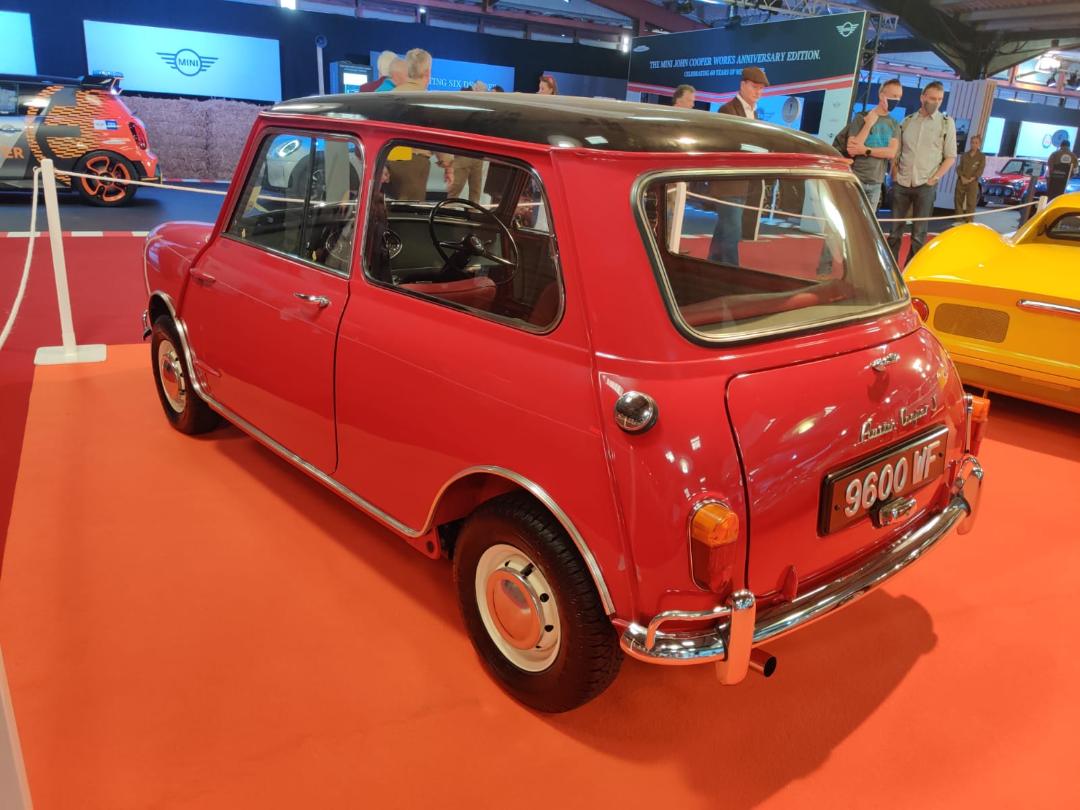

The Austin Mini Cooper S 1071 is the first chapter of the Cooper S story: a small-capacity performance Mini whose importance rests on its engineering and competition role, rather than an anniversary badge. Introduced in 1963, it occupies a distinct place between the earlier Cooper and the later 970 and 1275 Cooper S versions.
History and place in the MINI story
BMW Group Classic identifies the Austin 1071 as a March 1963 introduction. The specialist Mini Cooper Register places the first S announcement in spring 1963 and describes a short production career of roughly a year. Those records establish a narrow model identity. They do not justify treating every early Cooper, every replacement 1071 engine or every subsequently converted Mini as the same car.
Verified identity and specification reference
| Engine | 1,071 cc A-series inline-four |
|---|---|
| Archive output | 70 hp at 6,200 rpm |
| Production period | March 1963–August 1964 |
| Layout | Front engine, front-wheel drive |
Understanding the design
The attraction is the contrast between familiar small-saloon proportions and a more serious mechanical purpose. Read as a design, the 1071 makes a strong case for subtlety: the important distinctions are easier to understand through the specification and supporting records than through an elaborate exterior package. Its place in the Cooper S lineage is clearer when it is compared with its immediate engine-capacity relatives, rather than with the entire Mini production run.
Rarity and production scope
The Mini Cooper Register describes approximately 4,000 cars across the 1071 Cooper S programme. Austin and Morris are badge variants within that shared reference; it is not an Austin-only total.
The production reference applies to the source-defined model or edition. It is not a count of cars still surviving, and should not be multiplied across overlapping market allocations or badge variants.
Identification and documentation
For an individual Austin, match the body identity and production date to heritage documentation, then investigate the engine and major period components. Restoration photographs can explain repairs and changed fittings. Badges alone cannot distinguish an original Austin S from a later reconstruction. Keep the Austin and Morris identities separate while retaining the shared production reference.
Compare related profiles
Frequently asked questions
Is this a road-production edition?
This profile covers homologation model. Its rarity reference is stated above; the overall MINI model family is not assigned the same limit.
Does the image establish factory originality?
The photograph illustrates the source-identified subject. Individual originality, replacement components and restoration history require their own documentation.
Which date is used in the title?
1963 is the reference year for this edition, design presentation or historic event. A photographed car may have been built earlier.
Sources and further reading
Research checked 15 October 2026. Manufacturer specifications describe the period source and market identified above.
Built in limited numbers
The Mini Cooper Register describes approximately 4,000 cars across the 1071 Cooper S programme. Austin and Morris are badge variants within that shared reference; it is not an Austin-only total.
Gallery
Specifications
Factory specifications may vary by model year, market and configuration.
Identity & production
- Official model
- Austin Mini Cooper S 1071
Sources and verification
Source citations are being prepared for this profile.