1961 Lincoln Continental X-100 Presidential Limousine
Explore 1961 Lincoln Continental X-100 Presidential Limousine: sourced history, rarity, design and credited photography.
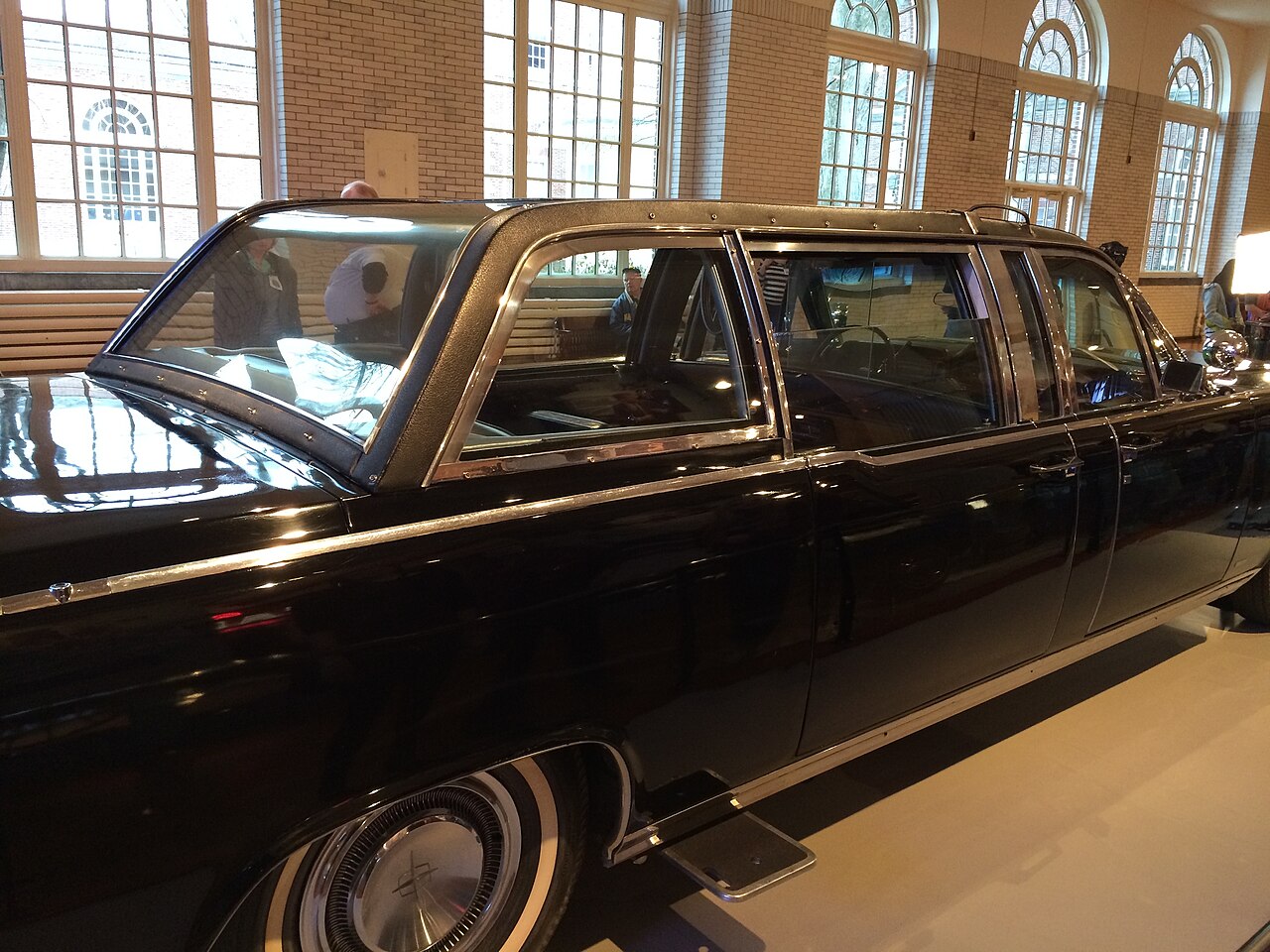
The X-100 is a documented presidential Continental whose configuration changed substantially during its service life. A later museum photograph must be read alongside that chronology, not treated as its original 1961 appearance.
History and verified identity
The Henry Ford identifies object 78.4.1 as the 1961 Lincoln Continental presidential limousine, manufactured at Wixom and customized by Hess & Eisenhardt in Cincinnati. Following President Kennedy’s death, it was rebuilt with a permanent roof, armor and black paint, then returned to service until 1977. The archive follows this individual vehicle and its dated alterations rather than generalizing its security specification to normal Continental production.
Reading the credited photograph
The supplied licensed museum photograph depicts the presidential limousine after its later roof and body alterations. Its long cabin and official display setting document a surviving historic object. The source credit identifies the photographer independently of the car’s makers, while the caption separates its 1961 chassis identity from the later configuration visible in the photograph.
Why this Lincoln belongs in the archive
The car’s significance includes the way an existing vehicle was adapted as official security expectations changed. Describing those alterations plainly is more informative than presenting the body as a timeless specification. A careful catalogue can connect the original parade role, later rebuilt appearance and custodial record while preserving the identity of the car throughout. Neutral wording also keeps the vehicle’s engineering and provenance readable without turning a tragic historical association into sensational presentation.
A car with more than one configuration
Continental X-100 Presidential Limousine should be understood as a sequence of dated configurations attached to an individual vehicle. Body changes can be historically important evidence, rather than a defect to hide in a catalogue. The useful questions concern when a roof, protective feature or trim arrangement was introduced, which institution records the change, and which form appears in the photograph. Those questions preserve the vehicle’s service history while avoiding a single specification assembled from incompatible dates.
For Continental X-100 Presidential Limousine, compare an original service-period view with the supplied later appearance before writing a description of the roof or body. The reference year identifies the vehicle’s foundation; a caption identifies a photographed moment. Both can be retained in the same dossier. If a component was replaced during official use, record that event alongside the institutional account. A museum object number provides a stable link between those different views and the individual car they document.
Why the identity matters
The collecting significance of Continental X-100 Presidential Limousine is tied to documented use and custodial evidence. Its place in a public collection can support a history that an ordinary model brochure could never establish. Conversely, a service history for this car cannot be transferred to another limousine merely because the grille or body shape resembles it. The record becomes more valuable when its individual identity, makers, modification sequence and credited images remain connected.
A useful comparison for this vehicle
The museum photograph is a useful place to begin a configuration timeline. Record the permanent roof and visible body arrangement as the form shown, then connect those observations with the institution’s account of later alterations. Do not reconstruct an original parade specification by selecting attractive details from images taken years apart. A different service-period photograph could legitimately show another configuration of the same car, provided it carries its own date and source. The Sunshine Special offers a related institutional comparison, but it remains another individual vehicle. Retaining each museum object number makes that distinction easy to maintain. It also lets the catalogue explain the relationship between a chassis reference year, a photographed appearance and a long official-service history without forcing them into one undated description.
Reading the evidence for this profile
The original source links below identify the programme and the historical statements used in this article. The photograph has its own creator and licence record, separate from the manufacturer’s vehicle history. Keep both when transferring this profile into a collection catalogue. A manufacturing tally describes how many cars belong to a defined original programme; it does not measure how many survive, how many are publicly visible, or how many retain all their original components. Those individual questions require dated chassis and restoration evidence. The reference year likewise describes the programme’s introduction or named historic configuration, while the supplied caption states the photographed setting and any established individual identity. This lets future research expand the car’s history without blurring the scope of the record already assembled here.
Specifications and verified rarity
| Reference year | 1961 |
|---|---|
| Model / programme | Continental X-100 Presidential Limousine |
| Body / role | Hess & Eisenhardt presidential chassis |
| Museum object | 78.4.1 |
| Special-purpose builder | Hess & Eisenhardt |
| Configuration note | Later rebuilt appearance distinguished from 1961 parade form |
| Exact manufacturing tally | Not established |
| Rarity evidence | Documented physical archive scope; fabrication census unassigned |
| Rarity scope | Documented physical Continental X-100 Presidential Limousine archive programme. Complete fabrication census unassigned; a photographed example is not proof of a one-car programme. |
| Inventory reference | LNC-054 — Verified |
Frequently asked questions
Why does a 1961 car appear with a later permanent roof?
The museum documents a subsequent security rebuild; the reference year identifies the original vehicle.
What does the reference year identify?
1961 is the documented programme or archival reference used for this profile. The original workbook year is retained separately when corrected.
Does the photograph authenticate every mechanical component?
It documents the visible named subject. Hidden hardware and individual originality require a build or inspection record.
Is the number of surviving examples established?
No survivor census is assigned. Original programme references, fabrication output and surviving-car counts are kept separate.
What rarity or archive scope is verified?
Documented physical Continental X-100 Presidential Limousine archive programme. Complete fabrication census unassigned; a photographed example is not proof of a one-car programme.
Who took the supplied photograph?
Chris Short from Detroit, MI, United States via Wikimedia Commons, under CC BY-SA 2.0. The original file and licence links accompany the image. Retain that credit when the photograph is uploaded, exported or reused.
Related Lincoln profiles
Sources and photo credits
Photograph: Chris Short from Detroit, MI, United States via Wikimedia Commons source, CC BY-SA 2.0. Source-provided photograph supplied without local cropping, retouching or text removal. A source thumbnail is used where available. The supplied licensed museum photograph depicts the presidential limousine after its later roof and body alterations.
Built in limited numbers
Documented physical Continental X-100 Presidential Limousine archive programme. Complete fabrication census unassigned; a photographed example is not proof of a one-car programme.
Gallery
Specifications
Factory specifications may vary by model year, market and configuration.
Identity & production
- Official model
- Continental X-100 Presidential Limousine