
1957 Continental Mark II Final Production
Explore 1957 Continental Mark II Final Production: sourced history, rarity, design and credited photography.
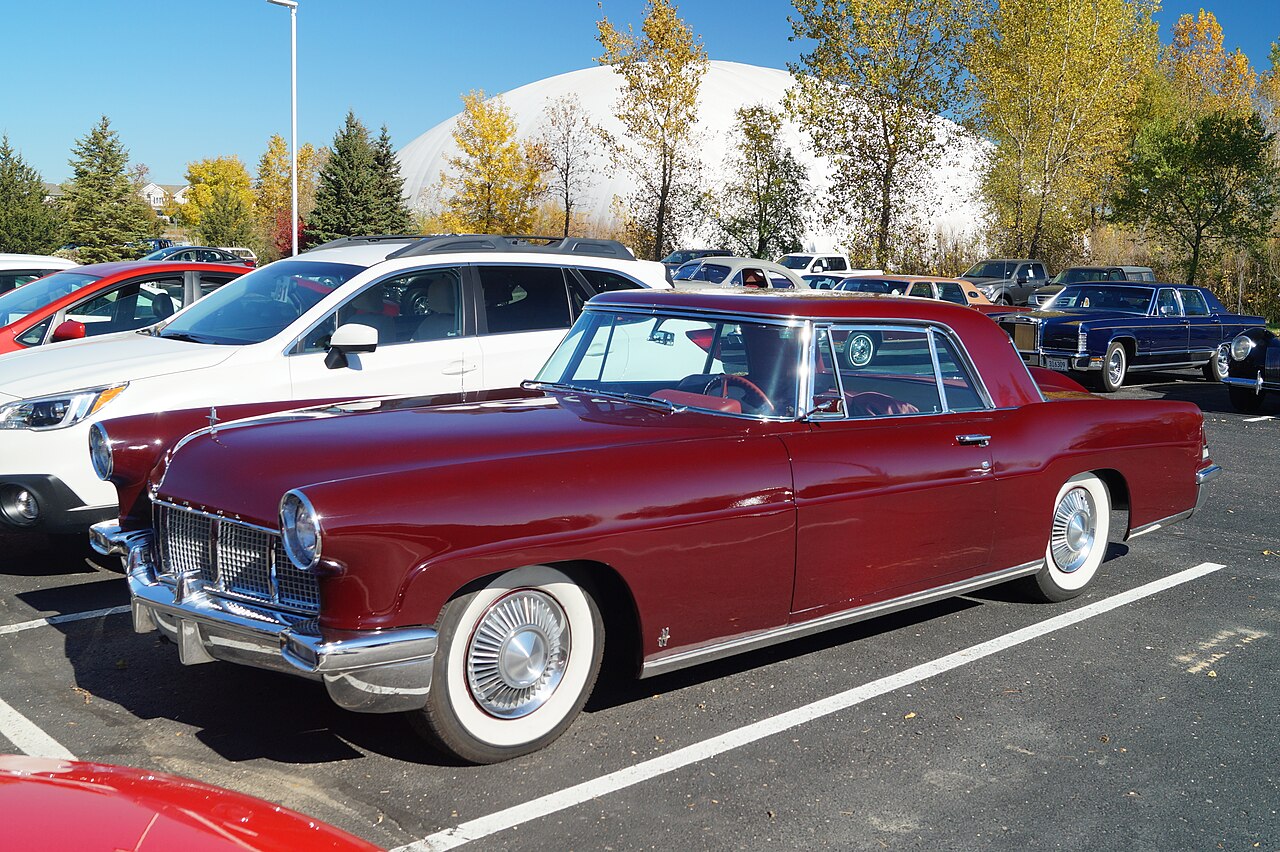

The 1957 Mark II belongs to Ford’s separate Continental Division. Its final-year rarity deserves a profile with the historically correct marque, rather than being silently renamed a Lincoln trim package.
History and verified identity
RM Sotheby’s reports 444 Mark IIs for 1957 and describes the period 368-cubic-inch, 300-horsepower V8 with Turbo-Drive automatic transmission. This profile follows the final model-year programme, not an asserted last-built chassis. The vehicle sits within Lincoln’s broader corporate history, but the Continental Division identity is retained in the make and manufacturer fields.
Reading the credited photograph
Greg Gjerdingen photographed a red 1957 Continental Mark II at an owners-club gathering. The restrained side trim, compact passenger roof and long body are easy to read from the front quarter. The image depicts a coupe rather than an independently commissioned convertible conversion. Its appearance is a photographic record of that car, not a claim that every final-year Mark II used the same colors.
Why this Lincoln belongs in the archive
The Mark II’s visual restraint makes small relationships matter: the roof length, front fender height and position of the wheels carry much of the character. It is a useful counterpoint to concepts whose identity rests on unusual doors or a dramatic canopy. Correct marque naming also adds value to the comparison. A corporate family relationship does not make the original division badge, body style or model-year production scope interchangeable with later Lincoln-branded Marks.
How the rarity scope works
The reference for Mark II Final Production covers the programme stated in the specification table. That boundary matters because a total can describe a chassis family, one model year, a body form or an announced allocation. It is not automatically a count of surviving cars. A catalogue that preserves the original boundary is easier to expand: a later body breakdown or build-sheet discovery can add detail without requiring the old total to be reinterpreted.
For a particular Mark II Final Production, the most useful supporting records are those that connect its chassis or serial identity to its original body and completion history. A photograph helps identify visible form, but color, trim and mechanical details can change during use or restoration. Keep the dated record alongside the present appearance. A documented alteration can be described accurately without being mistaken for the original specification of every car in the programme.
Comparing an individual car with the programme
A profile of Mark II Final Production gives a reader a model-level reference point. An individual vehicle dossier answers a different set of questions: whether its body is the original one, which components were replaced, and how its appearance developed. Those questions should be answered with evidence for that car. The supplied photograph is a credited example of the subject, and the period specifications describe the documented programme; neither is presented as a complete inspection of the illustrated vehicle.
A useful comparison for this vehicle
Compare the Mark II with the Continental Coupe by looking at the treatment of the cabin and the amount of exterior emphasis given to individual details. Both can be discussed within a wider personal-luxury history, but the original marque and division name must travel with each car’s record. A cataloguing shortcut that calls every related car a Lincoln would obscure part of that history. The Mark II photograph also records one color and finish combination; it is not a specification for the entire final-year output. Its place in the collection is strengthened by that precision. Correct naming, a defined year and a credited example allow a reader to understand the car’s corporate relationship while still recognizing the separate identity under which it was originally offered.
Reading the evidence for this profile
The original source links below identify the programme and the historical statements used in this article. The photograph has its own creator and licence record, separate from the manufacturer’s vehicle history. Keep both when transferring this profile into a collection catalogue. A manufacturing tally describes how many cars belong to a defined original programme; it does not measure how many survive, how many are publicly visible, or how many retain all their original components. Those individual questions require dated chassis and restoration evidence. The reference year likewise describes the programme’s introduction or named historic configuration, while the supplied caption states the photographed setting and any established individual identity. This lets future research expand the car’s history without blurring the scope of the record already assembled here.
Specifications and verified rarity
| Reference year | 1957 |
|---|---|
| Model / programme | Mark II Final Production |
| Body / role | Continental Division personal-luxury coupe |
| Original manufacturer | Ford Motor Company — Continental Division |
| Period engine | 368 cu. in. V8; period rating 300 hp |
| Period transmission | Turbo-Drive automatic |
| Exact manufacturing tally | Not established |
| Rarity evidence | 444 for the documented complete programme |
| Rarity scope | Published complete 1957 Mark II Final Production programme reference: 444. Exact independently audited completed tally unassigned; no survivor count implied. |
| Inventory reference | LNC-049 — Verified |
Frequently asked questions
Why does the make field say Continental?
The 1956–1957 Mark II was a Continental Division product; the Lincoln inventory affiliation is preserved separately.
What does the reference year identify?
1957 is the documented programme or archival reference used for this profile. The original workbook year is retained separately when corrected.
Does the photograph authenticate every mechanical component?
It documents the visible named subject. Hidden hardware and individual originality require a build or inspection record.
Is the number of surviving examples established?
No survivor census is assigned. Original programme references, fabrication output and surviving-car counts are kept separate.
What rarity or archive scope is verified?
Published complete 1957 Mark II Final Production programme reference: 444. Exact independently audited completed tally unassigned; no survivor count implied.
Who took the supplied photograph?
Greg Gjerdingen from Willmar, USA via Wikimedia Commons, under CC BY 2.0. The original file and licence links accompany the image. Retain that credit when the photograph is uploaded, exported or reused.
Related Lincoln profiles
Sources and photo credits
Photograph: Greg Gjerdingen from Willmar, USA via Wikimedia Commons source, CC BY 2.0. Source-provided photograph supplied without local cropping, retouching or text removal. A source thumbnail is used where available. Greg Gjerdingen photographed a red 1957 Continental Mark II at an owners-club gathering.
Built in limited numbers
Published complete 1957 Mark II Final Production programme reference: 444. Exact independently audited completed tally unassigned; no survivor count implied.
Gallery
Specifications
Factory specifications may vary by model year, market and configuration.
Identity & production
- Official model
- Mark II Final Production