1955 Chevrolet Corvette V8
1955 Chevrolet Corvette V8: verified history, production scope, design, specifications and collector details, with an authentic photo and full credit.
The 1955 Chevrolet Corvette V8 marks a major engineering turn in the early Corvette sequence. The sports-car shape is familiar from its first production years, but the V8 identity gives this reference-year subject a different place in Chevrolet history.
History and model identity
The Henry Ford’s transportation collection describes its 1955 Corvette as V8-powered and gives a 195-horsepower rating. The production reference records 700 Corvettes in total for 1955 while listing both six-cylinder and eight-cylinder base roadster configurations. This profile therefore uses 700 as a conservative annual ceiling, rather than claiming that every one of those 700 cars was a V8.
The 265-cubic-inch V8 belongs to the reference-year model context. It is the engine change that gives this profile its specific subject, but the production table used here does not establish a separate V8 tally. Leaving that field unset is more precise than importing a commonly repeated narrower figure without its supporting factory scope. The annual ceiling still keeps the subject within the batch’s rarity threshold.
Design, photographs and collector context
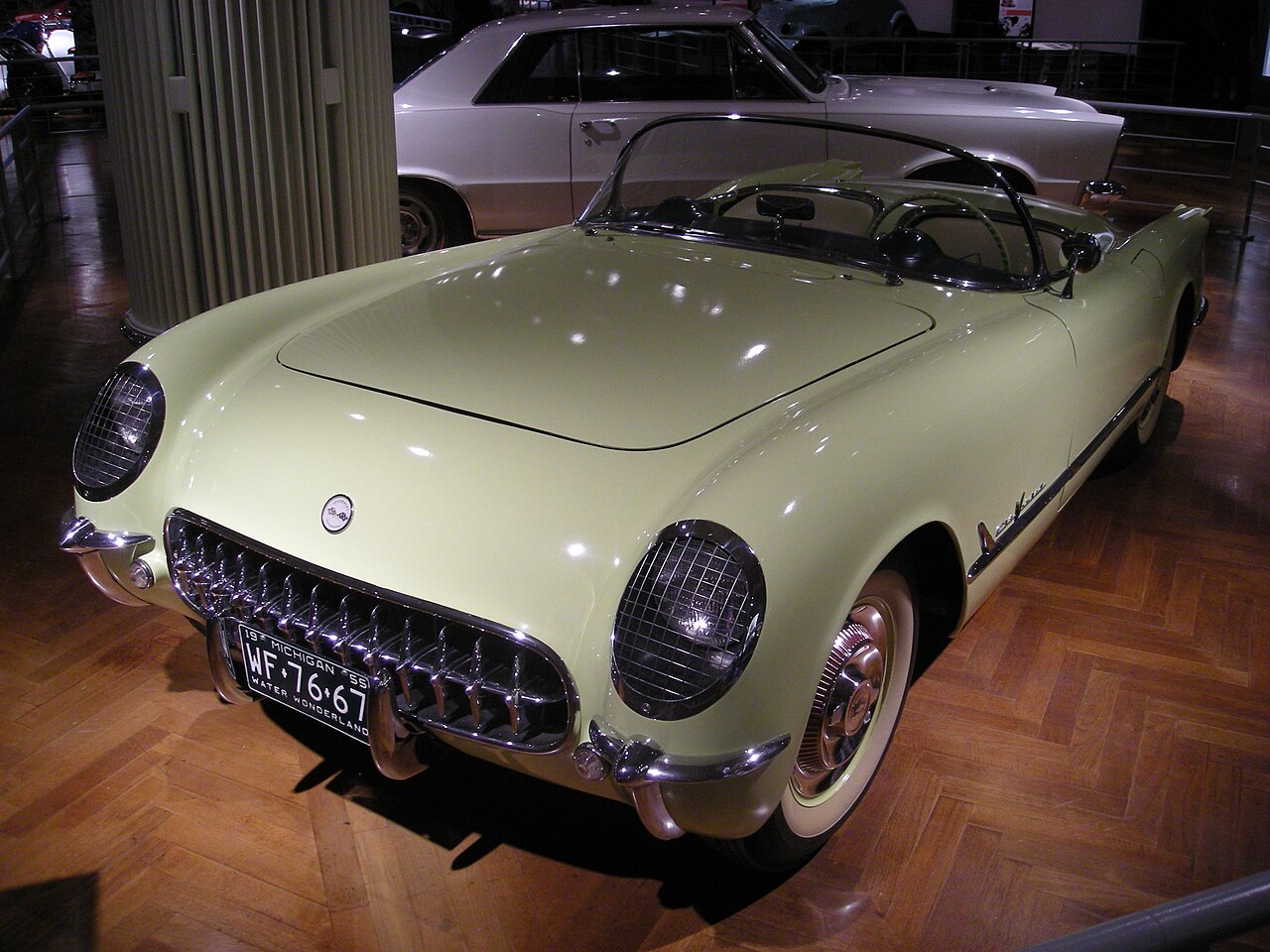
The Michael Barera photograph documents a white 1955 Corvette in The Henry Ford museum. Its restrained exterior gives the engine change a useful visual counterpoint: a major mechanical development can occur without replacing the entire body language at once. The museum reference and photo location also provide a stronger match for the V8 subject than an unidentified early Corvette at a roadside gathering.
A three-year comparison makes this car especially readable. The 1953 page establishes the beginning, the 1954 page preserves the continuation and the 1955 V8 page explains the transition. Each deserves a separate profile because reference year, production population and engineering context differ. The sequence should remain clear even when the photographs share white paint, red interiors and similar open-body proportions.
Reading the design in context
Read the museum photograph as an example of continuity around a mechanical change. The body remains recognisably part of the early open Corvette sequence, so the engine transition is explained chiefly through the accompanying records rather than through a dramatically different silhouette. This makes the 1955 subject a useful lesson in how an archive should combine images and documents. The image establishes the physical car and museum setting; the institutional commentary supplies the V8 context; a chassis file would then establish the individual installation history. None of those layers needs to substitute for the others. For a display, place the reference-year engine description beside the image and keep the annual ceiling wording nearby. A visitor can then understand both why the car has a separate profile and why its exact V8 population field is left unset. The result communicates a turning point without disguising the boundaries of the available production evidence or assigning a specification purely from appearance.
Specifications and rarity
| Reference year / history | 1955 |
|---|---|
| Model / project | Corvette V8 |
| Engineering context | 265-cubic-inch Chevrolet V8; museum reference rated at 195 hp |
| Design and collector theme | The V8 transition within a 700-car annual programme |
| Production / archive scope | Conservative ceiling of 700 for all 1955 production Corvettes, including the published six- and eight-cylinder configurations. Exact V8-specific output is left unset. |
| Exact scoped manufacturing tally | Unset; see scope description |
| Inventory reference | CHV-031 — Verified |
Building the individual collector record
For an individual car, preserve the build evidence and fitted-engine identity, plus dated records of any drivetrain restoration. Record whether a claimed V8 installation is original to that chassis. Keep the annual programme total separate from a body, engine or surviving-car count in collection software.
Documentary photograph
1955 Chevrolet Corvette at The Henry Ford museum, documented by the institution in V8 form; photograph by Michael Barera, August 2012.
Frequently asked questions
Does the figure 700 mean 700 V8 Corvettes?
No. It is the total 1955 Corvette annual production figure. It is used as a conservative parent ceiling for the V8 subject; the exact engine-specific count remains unset in this package.
Which engine defines the V8 profile?
The reference-year engine is Chevrolet’s 265-cubic-inch V8. The Henry Ford museum reference provides a 195-horsepower rating for its 1955 example.
Why use a museum photograph for this subject?
The photo records a car at The Henry Ford, whose own collection commentary identifies the 1955 V8 context. This gives the image a documented model setting without adding unsupported chassis claims.
What is the best companion profile?
The 1953 and 1954 production Corvette pages explain the preceding six-cylinder chapter. Read them in order to distinguish the body’s continuity from the later engine change.
What production or archive scope applies to this Corvette V8?
Conservative ceiling of 700 for all 1955 production Corvettes, including the published six- and eight-cylinder configurations. Exact V8-specific output is left unset.
Who took the photograph, and what credit must remain?
The supplied photograph is credited to Michael Barera via Wikimedia Commons under CC BY-SA 4.0. Its original file page and individual licence are linked in the photo credit. Keep the photographer name, source and licence visible when using the image; this version has no local retouching or cropping.
Sources and photo provenance
- Museum collection / original institutional account
- Production reference table
- Photo: Michael Barera — Henry Ford Museum August 2012 75 (1955 Chevrolet Corvette).jpg
Related Chevrolet profiles
Continue the chronology with 1954 Chevrolet Corvette and 1953 Chevrolet Corvette. Compare each page’s named production or project scope alongside its own documentary photograph.
Built in limited numbers
Conservative ceiling of 700 for all 1955 production Corvettes, including the published six- and eight-cylinder configurations. Exact V8-specific output is left unset.
Gallery
Specifications
Factory specifications may vary by model year, market and configuration.
Identity & production
- Official model
- Corvette V8