
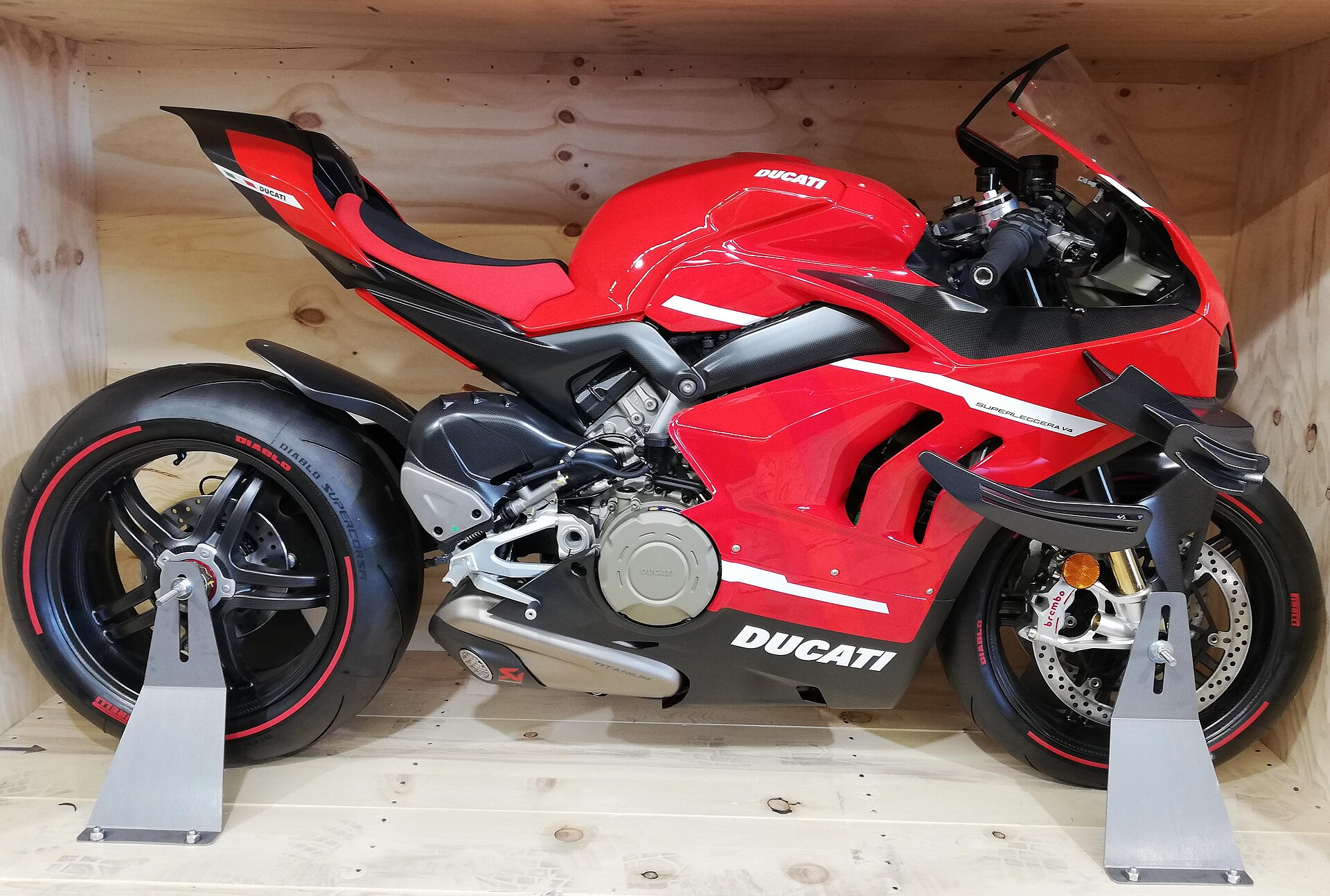
Ducati used the Superleggera name for two distinct limited motorcycles: the 1199 Superleggera, introduced in 2013, and the later Superleggera V4. Ducati's heritage record says 500 numbered 1199 examples were built. Its V4 launch release describes 500 individually numbered V4 motorcycles, while the start-of-production announcement identifies the first machine as #001 of a 500-unit scheduled series. Those are separate editions and separate denominators, even though the two numbers happen to match.
The more interesting contrast is what Ducati did with the weight-saving idea in each generation. The 1199 grew from the 1199 Panigale and pursued extreme lightness around a twin-cylinder platform. The V4 brought a different engine architecture, carbon-fibre load-bearing components and prominent aerodynamic wings. A 1199 profile and Superleggera V4 profile give the individual histories; this guide explains their relationship.
The short comparison
The 1199 Superleggera is Ducati's 2013 lightweight interpretation of the 1199 Panigale. Ducati's historical page says it built 500 numbered examples, claims more than 200 hp maximum power and quotes 155 kg dry weight. The Superleggera V4 is Ducati's later 500-bike numbered project based on V4 architecture. Ducati states that its road-legal configuration has 224 CV under European homologation figures, and that the included racing exhaust gives 234 CV in track configuration. The V4's carbon-fibre frame, subframe, swingarm and wheels are central to the engineering story. Each number must retain its unit, configuration and source.
A bare “500 made” can therefore mislead. It may refer to the 1199 or V4, and a “Superleggera V4” without a year can also be confused with a later named edition. Ducati has subsequently introduced the Superleggera V4 Centenario, with its own 500-bike main edition and 100-bike Tricolore edition. The Centenario is a different project. Do not add it to an earlier V4's production denominator or label an ordinary V4 as a Centenario because both names contain “Superleggera.”
What made the 1199 unusual?
Ducati says the 1199 Superleggera arose from the 1199 Panigale with a goal of reducing weight as far as possible. Its factory heritage page gives 155 kg dry weight and maximum power exceeding 200 hp. Ducati's later limited-series history describes the 2013 model as a 500-unit run. The manufacturer's own statements define both the size of the edition and the purpose behind it.
Dry weight is a particular measurement, not the mass of a ready-to-ride, fuelled motorcycle. A specification table that compares the 1199's dry figure with another bike's curb weight creates an apparent advantage or disadvantage that the data cannot support. The same caution applies to racing-kit and road-legal power figures. Keep each number with the state of the machine in which Ducati reported it.
The model name includes “1199” because the engine and generation matter. An ordinary Panigale 1199 is not automatically one of the numbered Superleggeras. A plate, distinctive fairing or aftermarket parts may prompt an inquiry, but individual membership should be established through frame identification and Ducati documentation. In a genuine example, restoration and replacement parts also deserve their own record; belonging to the series does not prove that every component is original.
What changed with the V4?
Ducati's V4 launch presents the later motorcycle as a 500-unit series. The maker describes its carbon-fibre frame, subframe, swingarm and wheels as a load-bearing structure, and states that those components saved 6.7 kg. This is a different material and architecture story from the earlier 1199, even though both pursue lightness. Ducati also describes testing the carbon components with methods including thermography, ultrasound and tomography.
Aerodynamics became much more explicit. Ducati says the V4's biplane wings could generate 50 kg of downforce at 270 km/h, a claim tied to that speed and configuration. It should not be shortened to “50 kg of downforce” without the speed condition. The fairing and wings tell us that the V4 project treated airflow as part of the total package, not merely as body styling.
The engine distinction is equally clear. Ducati identifies a 998 cc, 90-degree V4 for the Superleggera V4. It quotes 224 CV in the road-legal European homologation configuration and 234 CV with the included titanium Akrapovič exhaust for track use. Those are two configurations of the same model, not evidence of two different production totals. A racing-kit figure should never be presented as the specification of a road-legal bike without qualification.
The meaning of 500 in each series
For the 1199, Ducati's retrospective explicitly says 500 numbered units were built. For the V4, the cited production-start story says #001 was the first of 500 scheduled units and describes a maximum of 500 numbered motorcycles. Its launch story presents the edition as 500 individually numbered bikes. The wording reflects what each source records at its publication date. A later dated factory completion statement would be the ideal source if a final built total were needed.
Neither 500 is a count of motorcycles in original condition today. A numbered bike can have been repaired, raced, repainted or imported to another market. Number XXX/500 identifies an intended place within its own series. Ducati says the V4's progressive number, corresponding to the chassis number, appears on the steering head and ignition key, and that a certificate of authenticity accompanies the bike. For an individual motorcycle, compare those records with the physical frame and ownership file.
The existence of two 500-unit series does not make a single 1,000-unit “Superleggera edition.” The model names, engine layouts, years and parts histories differ. The later Centenario and its Tricolore variant create still more reasons to use full designations. The limited-production evidence guide explains why a denominator must name the exact population it counts.
Road equipment and track equipment
Ducati says each Superleggera V4 was supplied with a racing kit, including a titanium exhaust for track use, parts to replace or remove road equipment, stands and other accessories. The maker also describes a wooden delivery crate and a 1:10 scale model personalized with the bike number. These details can matter in documenting an individual example, but a missing accessory does not change the factory series to which the frame belongs. It changes the completeness of that particular motorcycle's package.
The V4's 234 CV track-kit output cannot automatically be treated as street-legal in every jurisdiction. Ducati explicitly distinguishes the road-homologated exhaust from the supplied track exhaust. Similarly, a photograph of a stripped track-prepared bike cannot tell a reader what equipment it originally carried or whether the parts were later reinstalled. An individual listing should describe the current state and retained original components.
For the 1199, published dry weight and power are likewise model claims, not a guarantee for a used machine with changed exhaust, wheels or engine setup. The useful comparison is between the engineering programmes as their maker describes them, followed by a separate inspection of any bike offered for sale or shown in a collection.
How does the BMW HP4 Race fit?
BMW's HP4 Race announcement documents a 750-unit limited series. It offers a useful third example of a manufacturer defining a finite lightweight performance project. But it is not a Ducati Superleggera, and its factory intention and equipment deserve their own description. The BMW HP4 Race profile and limited-run motorcycle comparison connect these engineering approaches without reducing them to a ranking by edition size.
The Honda RC30 is another historically important contrast. Honda's historical source gives 4,885 sold worldwide, which should remain a sales figure. Its racing-related purpose differs from the modern Ducati's pursuit of an extreme numbered lightweight edition. Comparing the reasons for the projects is more informative than comparing “500” with an incorrectly relabelled Honda production total.
Checking an individual Superleggera
Start with the complete model designation and a frame identification record. Match the Ducati-issued documentation, numbered plate and any certificate to the bike itself. Then inventory the original road components and, for a V4, the racing-kit pieces supplied or retained. A parts list and service history will explain what has changed since delivery.
Inspect claims about originality carefully. A replacement fairing can be authentic Ducati equipment without being the machine's delivered fairing. A track exhaust can be part of an original supplied kit without being road homologated. A repainted bike can remain a genuine numbered Superleggera. Clear documentation allows these statements to coexist instead of forcing a simplistic “original or fake” label.
The model page cannot establish the condition of an advertised individual bike. It gives the baseline against which records and inspection can be compared. On a scarce and specialized machine, that difference between series identity and current condition is central to any credible account.
Frequently asked questions
Were there 500 of each Ducati Superleggera?
Ducati says 500 numbered 1199 Superleggeras were built. Its V4 launch and production-start announcements describe a separate 500-unit numbered V4 series. They are two different models.
Is the Superleggera V4 a four-cylinder 1199?
No. The 1199 belongs to the Panigale twin-cylinder generation. Ducati describes the later Superleggera V4 with a 998 cc V4 engine and a carbon-fibre load-bearing structure.
Is 234 CV the V4's street-legal output?
Ducati quotes 224 CV for the European road-legal configuration and 234 CV with the supplied titanium track exhaust. State the configuration when using either figure.
Does the numbered plate prove authenticity?
It is a useful identification feature, but compare it with the frame number, factory records and certificate. A plate alone does not document ownership history or condition.
Is the V4 Centenario the same motorcycle?
No. Ducati introduced the separately named V4 Centenario later with its own edition structure. Its 500 main examples and 100 Tricolore examples should not be added to the earlier Superleggera V4's denominator.
Manufacturer sources
The 1199 figures and origin appear in Ducati's 1199 heritage record. The later motorcycle's architecture and configuration are documented in Ducati's V4 launch and production-start announcement. Ducati's Centenario announcement defines that later edition separately.
What a useful side-by-side listing should show
A listing for either model should begin with the exact factory name rather than the generic word “Superleggera.” The identity line can then show year, frame number as appropriately redacted for public display, edition number, market of delivery and document type used to verify them. The 1199's build total is established in Ducati's historical account; an individual bike's place in that run needs its own evidence. The V4's steering-head number and certificate create a particularly clear cross-check when both remain with the motorcycle.
The equipment section should separate factory-delivered accessories from later additions. For a V4, record whether the original racing kit, road-legal exhaust, keys, certificate, crate and numbered scale model accompany the bike. A complete list can be more useful than a vague “all extras included.” Ducati's production release enumerates many of those items, giving a buyer a factory checklist. An absence needs explanation; it does not itself prove the bike is misidentified.
Next record the state of its finish, mechanical parts and recent maintenance. Parts may be original, Ducati replacements or aftermarket modifications. Those are different statements. The presence of a track exhaust says something about current configuration; it does not prove that the bike has raced. A low odometer reading says little about how long a machine has sat between services. Specialized carbon parts warrant a condition assessment appropriate to their construction and prior use.
Why edition size is not the whole comparison
Both bikes' 500-unit figure is memorable precisely because it is easy to repeat. Yet a reader deciding which history to explore learns more from the 1199's place in the Panigale twin era and the V4's carbon structure and aerodynamic development. One series establishes a 2013 benchmark for Ducati's pursuit of low dry weight; the other shows how the company reinterpreted that premise when its superbike architecture changed. Their shared name indicates an idea, not identical engines, identical equipment or identical performance measurements.
If a new Ducati edition uses the Superleggera name, it should have its own page and source record. The already announced V4 Centenario illustrates why this matters. A search result for “Superleggera V4 500” can lead to more than one generation unless the edition and year appear in the title and opening sentence. The same precision helps internal links: the 1199 and earlier V4 profiles answer different questions, and neither should be silently redirected to the Centenario.
