1996 Renault Sport Spider Roadster
Explore the Renault Sport Spider Roadster: history, verified identity, specification references, rarity evidence and real credited photos.
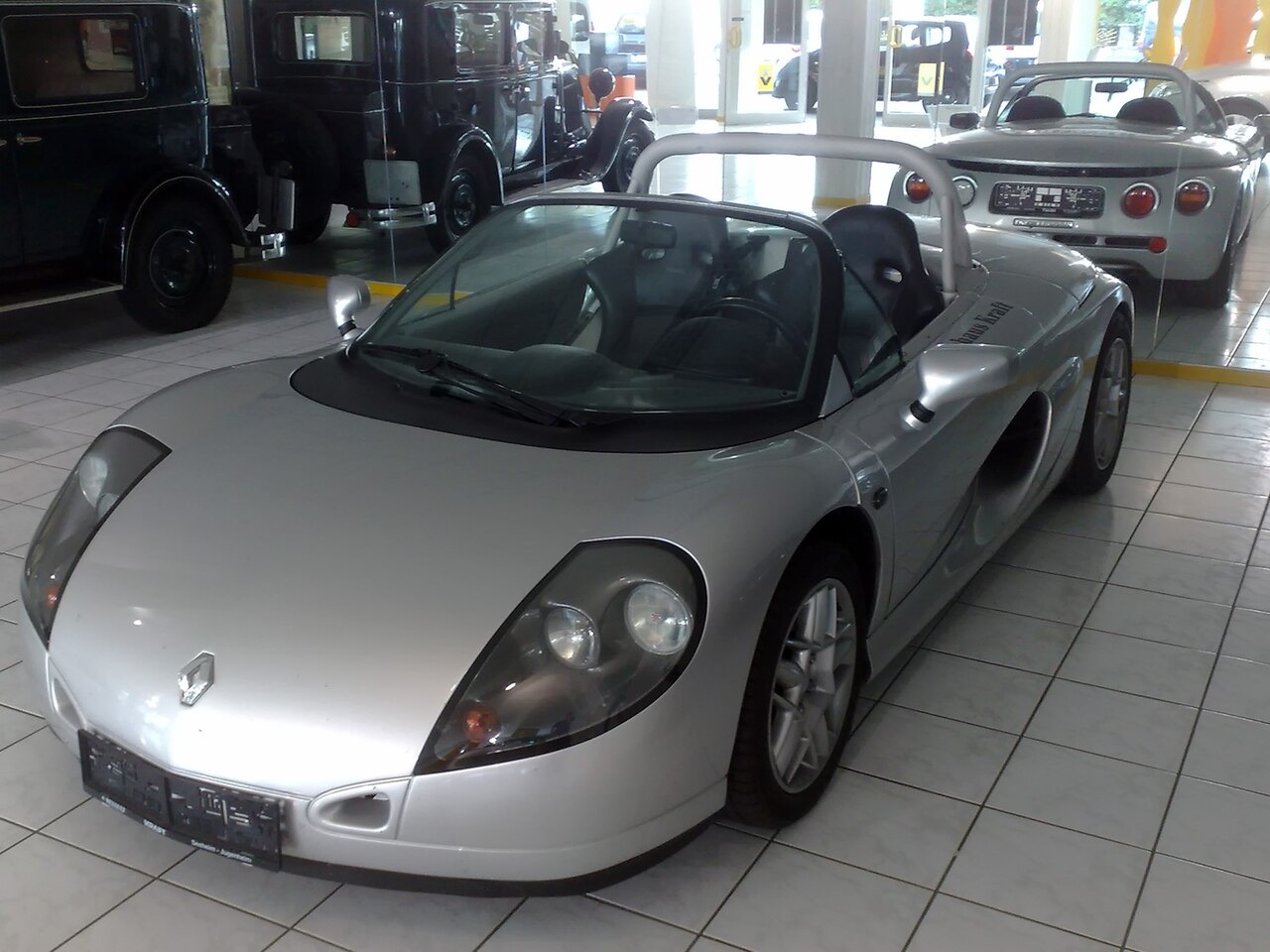
The Renault Sport Spider reduced the road sports car to a light structure, a mid-mounted engine and a very exposed cockpit. Windscreenless and windscreen-equipped versions belong to one road programme here, with the factory’s wider Spider production reference kept separate from the racing Trophy subset.
A new Renault Sport statement
The Spider was unveiled at Geneva in 1995 and the museum places the production period from 1996 to 1999. Its Dieppe manufacture connected it with specialist sports-car building while retaining Renault branding. This profile uses the production reference year and consolidates the inventory’s later windscreen-equipped entry. A different screen arrangement is meaningful specification information, but it does not justify counting the entire programme a second time.
Lightness begins with the structure
Renault describes an aluminium chassis and a two-litre four-cylinder engine behind the occupants, driving the rear wheels. Its museum power reference is 150 hp for the road car. That combination explains the Spider’s character more usefully than a comparison based on power alone. The structure and suspension need to be assessed as a complete system, particularly where a car has accumulated track use or undergone repairs.
An intentionally sparse cockpit
The windscreenless version used an air deflector, while the later screen-equipped version offered a different experience of the same exposed roadster idea. Renault’s account emphasises the absence of power steering, assisted braking, ABS and heating in its described specification. Market and version details should still be checked for an individual car. The appeal lies in deliberate simplicity, not in assuming every surviving Spider has identical original equipment.
Road cars and Trophy cars share an outer boundary
The manufacturer’s 1,726-vehicle reference covers the Spider programme and includes the Trophy racing subset. Its sources disagree on whether that subset comprised 80 or 90 cars, so this profile does not calculate a supposedly exact road-only remainder. The combined reference still establishes a low-volume programme. Screen versions, racing versions and later appearances are not used to multiply the same factory figure into several independent runs.
Renault Belgium: Spider anniversary and production scope
Inspect the aluminium car as an aluminium car
A collector file should establish the chassis identity, original delivery specification and screen arrangement before evaluating originality. Pay particular attention to documented chassis repairs, accident history, corrosion at material interfaces and changes made for track use. Those are suggested inspection priorities, not claims about the photographed example. Match the build record to the actual equipment rather than accepting a modified cockpit or replacement body panel as proof of a distinct factory edition.
Specifications and identity reference
| Presentation / production | 1995 reveal; museum production reference 1996–1999 |
|---|---|
| Engine reference | 1,998 cc four-cylinder; 150 hp road specification |
| Layout | Rear mid-engine; rear-wheel drive |
| Structure | Aluminium chassis |
| Programme quantity | 1,726 including Trophy; no exact road-only remainder inferred |
Rarity and production scope
Renault reports 1,726 vehicles across the Spider programme, including Trophy competition cars. The road-only quantity is not derived because Renault’s sources disagree on the Trophy subset. Windscreenless and windscreen-equipped road references REN-094 and REN-097 are consolidated in this profile. The shared programme figure is not added to itself, and no separate cap is invented for either screen arrangement.
What the photograph represents
A silver Renault Sport Spider with a windscreen in a later display. It illustrates the consolidated road programme, including its screen-equipped variation; it is not presented as the original windscreenless build specification.
Related Renault heritage profiles
Frequently asked questions
Are the two screen arrangements separate production totals?
No. They are retained as variations within one road Spider profile, with the later inventory entry consolidated as an alias.
Does 1,726 mean road Spiders only?
No. Renault’s accounts include the Trophy racing cars in that wider figure; the exact road-only remainder is not asserted.
What is the production-count boundary for this profile?
Renault reports 1,726 vehicles across the Spider programme, including Trophy competition cars. The road-only quantity is not derived because Renault’s sources disagree on the Trophy subset. Windscreenless and windscreen-equipped road references REN-094 and REN-097 are consolidated in this profile. The shared programme figure is not added to itself, and no separate cap is invented for either screen arrangement.
Sources and further reading
Research checked 17 October 2026. Linked factory announcements and heritage records support the specifically attributed claims. Photographic descriptions identify the illustrated subject. Design analysis and suggested authentication steps are editorial interpretation.
Built in limited numbers
Renault reports 1,726 vehicles across the Spider programme, including Trophy competition cars. The road-only quantity is not derived because Renault’s sources disagree on the Trophy subset. Windscreenless and windscreen-equipped road references REN-094 and REN-097 are consolidated in this profile. The shared programme figure is not added to itself, and no separate cap is invented for either screen arrangement.
Gallery
Specifications
Factory specifications may vary by model year, market and configuration.
Identity & production
- Official model
- Renault Sport Spider Roadster
Sources and verification
Source citations are being prepared for this profile.