1994 Renault Espace F1
Explore the Renault Espace F1: history, verified identity, specification references, rarity evidence and real credited photos.
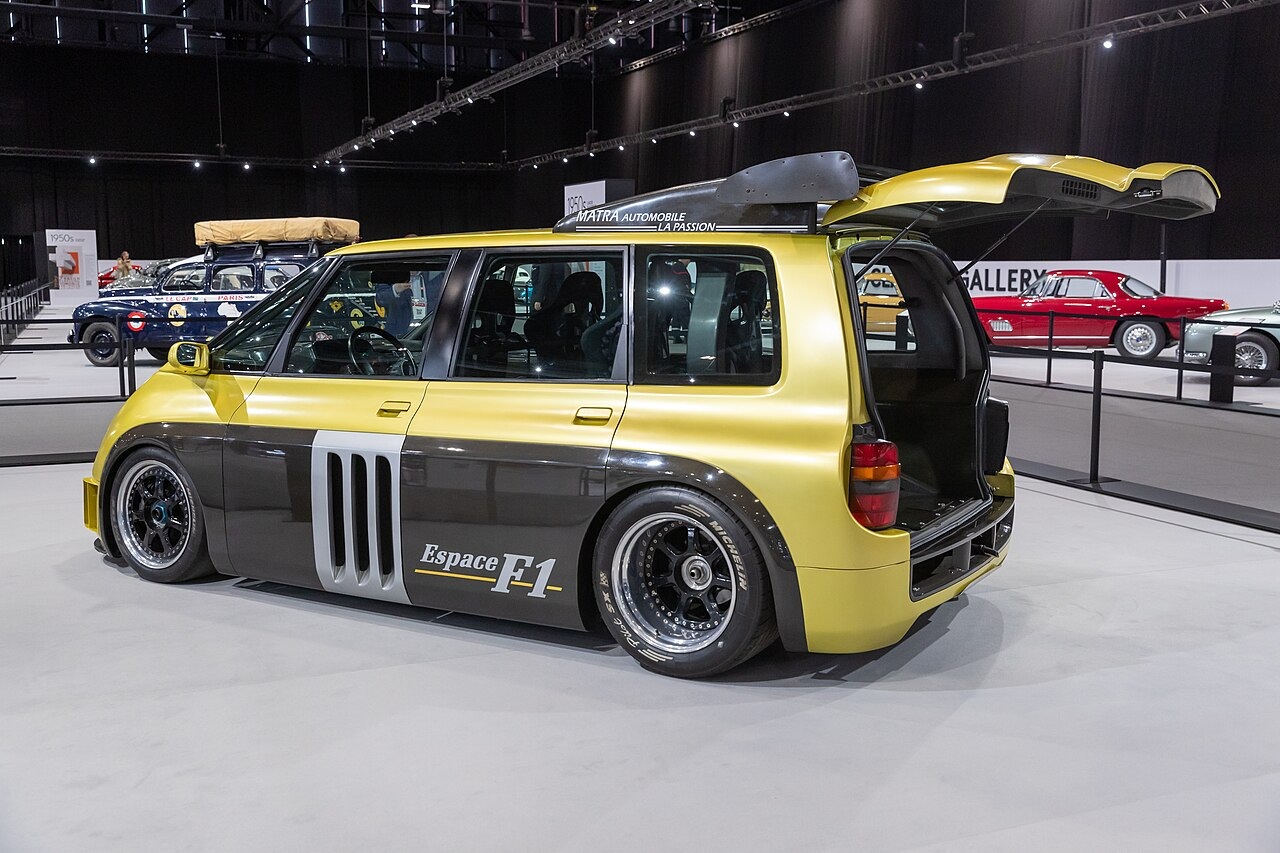
The Renault Espace F1 combined the recognisable form of a family people carrier with Formula One machinery. It is one of Renault’s most memorable experiments, but the verified identity includes an important distinction: the programme produced a running vehicle and a static show model, with different debut dates.
A celebration with an improbable silhouette
Renault’s January 2026 heritage account dates the Espace F1 presentation to the 1994 Paris Motor Show and connects it to the Espace’s tenth anniversary. Renault, Matra and Williams collaborated on the project. The inventory’s 1995 date relates to the running version’s public debut rather than the first show presentation. Both dates belong in the history, with 1994 used as the programme’s primary reference year.
Renault: Espace F1 heritage account, January 2026
An experimental structure beneath the MPV outline
The project used composite construction and a centrally placed Formula One V10, with four bucket seats arranged around the machinery. It was not a normal Espace fitted with a more powerful showroom engine. Its exaggerated intakes, wing and specialised interior expressed a fundamentally different engineering task. For a collector, that makes it an experimental object whose preservation involves prototype construction and operating systems rather than ordinary model servicing.
Two physical vehicles, different roles
The 2026 factory account explicitly distinguishes a drivable vehicle from a static model. The static version appeared in Paris in 1994; the running version debuted at Magny-Cours the following year with Alain Prost. This is stronger evidence than the loose one-of-a-kind language often used in retrospective descriptions. A photograph of a display must not be used to infer that its particular chassis contains an operational V10 installation.
Renault: Espace F1 heritage account, January 2026
Performance belongs to the running configuration
Renault’s heritage release gives approximately 800 PS, 2.8 seconds from rest to 100 km/h and around 310 km/h for the running vehicle. These are manufacturer historical claims, not performance tests of the exhibited object in this package. The figures help explain the project’s promotional impact, but they do not describe the static show model or certify what either vehicle can safely do in its current condition.
Keep prototype provenance attached to the object
A proper file should establish whether the object is the running car, the static show model or a later reconstruction. Construction records, custody history and mechanical inspection are more decisive than yellow paint or a large rear wing. The Geneva photograph is deliberately treated as a programme reference without assigning operating status. Any engine-origin claim should be checked against the particular car’s build documentation, since factory retrospectives describe the donor F1 context differently.
Specifications and identity reference
| Programme presentation | 1994 Paris Motor Show |
|---|---|
| Running-version debut | 1995, Magny-Cours |
| Collaborators | Renault, Matra and Williams |
| Physical scope | One running vehicle and one static show model |
| Running performance reference | Approximately 800 PS; manufacturer historical claim |
Rarity and production scope
Renault’s January 2026 heritage release identifies two Espace F1 vehicles: a running prototype and a static show model. The profile therefore uses a two-vehicle programme scope and rejects an exclusive one-off claim. Neither object belongs in road-production totals. The supplied Geneva display photograph is not used to determine which of the two vehicles it depicts or to certify current mechanical operation.
This is an Archive record. Concepts, restored heritage vehicles, works cars and competition programmes are not added to customer road-production totals. A programme profile does not establish how many physical chassis were made, and repeated exhibition appearances do not create additional vehicles.
What the photograph represents
Espace F1 exhibited at the 2024 Geneva show. Programme illustration only: the photograph is not used to establish whether this display is the running prototype or the static show model, and its presence does not prove current mechanical operation.
Related Renault heritage profiles
Frequently asked questions
Why does this profile use 1994 rather than 1995?
The static show model was presented in 1994. The running version’s 1995 debut is documented separately.
Were both Espace F1 vehicles drivable?
No. Renault distinguishes one running vehicle from one static show model; performance figures should not be assigned to both.
What is the production-count boundary for this profile?
Renault’s January 2026 heritage release identifies two Espace F1 vehicles: a running prototype and a static show model. The profile therefore uses a two-vehicle programme scope and rejects an exclusive one-off claim. Neither object belongs in road-production totals. The supplied Geneva display photograph is not used to determine which of the two vehicles it depicts or to certify current mechanical operation.
Sources and further reading
Research checked 17 October 2026. Linked factory announcements and heritage records support the specifically attributed claims. Photographic descriptions identify the illustrated subject. Design analysis and suggested authentication steps are editorial interpretation.
Built in limited numbers
Renault’s January 2026 heritage release identifies two Espace F1 vehicles: a running prototype and a static show model. The profile therefore uses a two-vehicle programme scope and rejects an exclusive one-off claim. Neither object belongs in road-production totals. The supplied Geneva display photograph is not used to determine which of the two vehicles it depicts or to certify current mechanical operation.
Gallery
Specifications
Factory specifications may vary by model year, market and configuration.
Identity & production
- Official model
- Renault Espace F1
Sources and verification
Source citations are being prepared for this profile.