1941 Lincoln Continental Cabriolet
Explore 1941 Lincoln Continental Cabriolet: sourced history, rarity, design and credited photography.
The 1941 Continental Cabriolet preserves the original Continental idea in a small production body programme. Its open roof and long hood give it a distinct place beside the later postwar coupe.
History and verified identity
RM Sotheby’s reports 400 Continental Cabriolets for 1941 and describes the period 292-cubic-inch L-head V12, rated at 120 horsepower, with a three-speed manual transmission. The source also explains that the Zephyr designation was dropped from the Continental name for this model year. Its auction chassis has a specific build record; that individual’s colors, body number and completion date are not assigned to the car in this profile’s photograph.
Reading the credited photograph
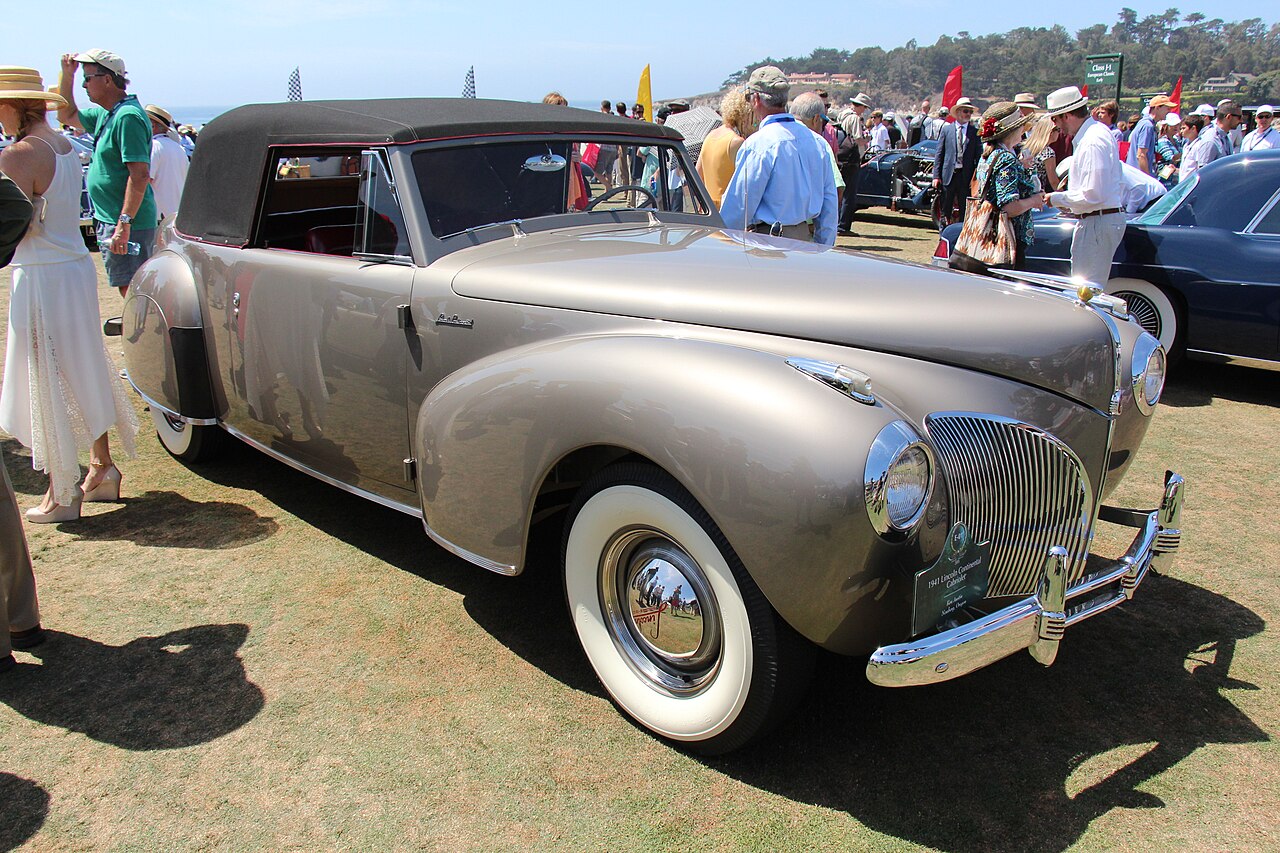
Sicnag photographed this 1941 Continental Cabriolet with its fabric roof raised at an outdoor gathering. The light body contrasts with the dark top, and the curved front fenders lead toward the narrow upright grille. The image illustrates the named open body, without using a Derham custom coupe or a later-year convertible as a substitute.
Why this Lincoln belongs in the archive
The Cabriolet is a useful example of how a roof changes the reading of a design. Its fabric upper section gives the passenger compartment a different visual weight from a fixed steel coupe roof, while the hood and fenders continue the same formal language. For comparison, a later Continental can show how front-end detailing evolved without implying that the earlier car lacked its own identity. Rarity here follows the defined 1941 Cabriolet output, not every Continental built across the prewar and postwar years.
How the rarity scope works
The reference for Continental Cabriolet covers the programme stated in the specification table. That boundary matters because a total can describe a chassis family, one model year, a body form or an announced allocation. It is not automatically a count of surviving cars. A catalogue that preserves the original boundary is easier to expand: a later body breakdown or build-sheet discovery can add detail without requiring the old total to be reinterpreted.
For a particular Continental Cabriolet, the most useful supporting records are those that connect its chassis or serial identity to its original body and completion history. A photograph helps identify visible form, but color, trim and mechanical details can change during use or restoration. Keep the dated record alongside the present appearance. A documented alteration can be described accurately without being mistaken for the original specification of every car in the programme.
Comparing an individual car with the programme
A profile of Continental Cabriolet gives a reader a model-level reference point. An individual vehicle dossier answers a different set of questions: whether its body is the original one, which components were replaced, and how its appearance developed. Those questions should be answered with evidence for that car. The supplied photograph is a credited example of the subject, and the period specifications describe the documented programme; neither is presented as a complete inspection of the illustrated vehicle.
A useful comparison for this vehicle
The 1941 Cabriolet is a useful counterpart to the postwar Coupe because the two photographs emphasize different passenger-body forms. Begin with the roof and rear side window rather than treating the front grille as the only identifier. An open body can retain a formal profile with its fabric top raised, while a fixed-roof car organizes that upper volume permanently. The photographed Cabriolet also offers a cleaner view of the relationship between the hood and front fenders. A collector can use that comparison to separate body identity from finish and restoration presentation. A pale car and a dark car may look very different at first glance, but paint alone does not establish the programme or change which historical body is being documented.
Reading the evidence for this profile
The original source links below identify the programme and the historical statements used in this article. The photograph has its own creator and licence record, separate from the manufacturer’s vehicle history. Keep both when transferring this profile into a collection catalogue. A manufacturing tally describes how many cars belong to a defined original programme; it does not measure how many survive, how many are publicly visible, or how many retain all their original components. Those individual questions require dated chassis and restoration evidence. The reference year likewise describes the programme’s introduction or named historic configuration, while the supplied caption states the photographed setting and any established individual identity. This lets future research expand the car’s history without blurring the scope of the record already assembled here.
Specifications and verified rarity
| Reference year | 1941 |
|---|---|
| Model / programme | Continental Cabriolet |
| Body / role | Prewar two-door cabriolet |
| Period engine | 292 cu. in. L-head V12 |
| Period rated output | 120 hp |
| Period transmission | Three-speed manual |
| Exact manufacturing tally | Not established |
| Rarity evidence | 400 for the documented complete programme |
| Rarity scope | Published complete 1941 Continental Cabriolet programme reference: 400. Exact independently audited completed tally unassigned; no survivor count implied. |
| Inventory reference | LNC-030 — Verified |
Frequently asked questions
What does the 400-car reference cover?
The 1941 Continental Cabriolet body programme; it does not include the coupe.
What does the reference year identify?
1941 is the documented programme or archival reference used for this profile. The original workbook year is retained separately when corrected.
Does the photograph authenticate every mechanical component?
It documents the visible named subject. Hidden hardware and individual originality require a build or inspection record.
Is the number of surviving examples established?
No survivor census is assigned. Original programme references, fabrication output and surviving-car counts are kept separate.
What rarity or archive scope is verified?
Published complete 1941 Continental Cabriolet programme reference: 400. Exact independently audited completed tally unassigned; no survivor count implied.
Who took the supplied photograph?
Sicnag via Wikimedia Commons, under CC BY 2.0. The original file and licence links accompany the image. Retain that credit when the photograph is uploaded, exported or reused.
Related Lincoln profiles
Sources and photo credits
Photograph: Sicnag via Wikimedia Commons source, CC BY 2.0. Source-provided photograph supplied without local cropping, retouching or text removal. A source thumbnail is used where available. Sicnag photographed this 1941 Continental Cabriolet with its fabric roof raised at an outdoor gathering.
Built in limited numbers
Published complete 1941 Continental Cabriolet programme reference: 400. Exact independently audited completed tally unassigned; no survivor count implied.
Gallery
Specifications
Factory specifications may vary by model year, market and configuration.
Identity & production
- Official model
- Continental Cabriolet