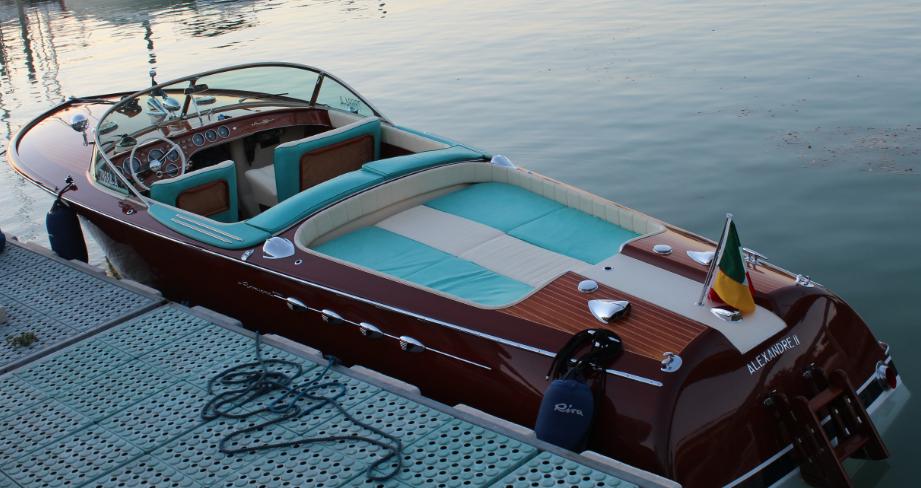
Riva Ariston
Riva’s mahogany runabout launched in 1950; Ferretti Group reports 1,012 built over 26 years.
The Riva Ariston is one of the defining names in the yard's wooden-runabout history. Riva's 2022 heritage announcement says the model launched in 1950 and that 1,012 boats were built over a 26-year production run. That is a manufacturer-published model count, not an estimate of the number that survive today. It gives the Ariston a clear historical scale without asking a listing or an auction caption to supply the facts.
Riva displayed an Ariston alongside a Corsaro and Aquarama in that heritage presentation. Its company history traces the Sarnico yard and Carlo Riva's era, then describes the continuation of wooden runabout production even after fibreglass models arrived. Together these sources establish the Ariston's place in the yard's story. They do not, by themselves, identify the year, engine or original finish of any particular surviving hull. This guide connects the model history to the documents a collector should examine.
The Ariston's place in Riva history
Riva's narrative begins with Pietro Riva's work at Lake Iseo in 1842 and the Sarnico yard that grew across generations. Ernesto Riva introduced internal-combustion engines to the yard's boats, according to the company's history. Carlo Riva subsequently shaped the postwar runabout image that became internationally recognizable. The Ariston's 1950 launch belongs to this earlier postwar period, before the Aquarama's 1962 debut.
That order matters. The Ariston is not a derivative of the Aquarama. Its run began earlier, and it had a 26-year production span according to Riva's own heritage statement. A casual description such as “an early Aquarama” may sound evocative but obscures an independent model and its own production history. Comparison is useful only when it preserves the chronology and the distinctions between model names.
The three-boat display in 2022 also places the Ariston among milestones rather than treating it solely as a pretty vintage object. Riva described the Corsaro as its first series-produced wooden hull, identified the Ariston with its 1950 launch and 1,012 examples, and marked the Aquarama's sixtieth anniversary. Those statements describe three different accomplishments. An article about the Ariston should not import the Aquarama's production figures or the Corsaro's first-of-kind status.
What “1,012 built” actually tells us
The manufacturer says 1,012 Aristons were constructed over 26 years. This is a production figure for the model as Riva named it in its 2022 communication. It is not an annual breakdown, a count of extant boats or a promise that each retains its original equipment. The count can be stated confidently with that scope and citation. A more detailed chassis-by-chassis chronology would need factory archival data beyond the two public pages used here.
Production length matters as much as the total. A model built over decades can have year-specific differences, changing engines, instruments, fittings and materials. This profile avoids declaring a single engine output, top speed, length or cockpit layout universal across all 1,012 hulls without a dated manufacturer specification. A collector should begin with the hull's build year and original order sheet before deciding which catalogue applies.
Rarity language should remain precise. An Ariston may be uncommon at a given marina or in a particular sales market, but the production figure alone cannot establish a current survivor count. An authenticated hull with original parts and extensive records can be more significant to a collector than another example in unknown condition; that is a judgment about provenance, not a revision of the model count. “One of 1,012 built” needs proof that the subject really is an Ariston.
Wood, design and the runabout experience
Riva's history describes a business that continued wooden runabouts well into the era of fibreglass production. Wood is central to the Ariston's cultural identity, but a vintage wooden boat is also an assemblage of structure, fittings and maintenance decisions. A luminous finish does not alone prove sound timber, original construction or correct restoration. The beauty of the surface and the condition beneath it should be evaluated separately.
The yard credits Giorgio Barilani's entry in 1956 with strengthening its design programme. That is historical context, not proof that he designed every Ariston built before or after his arrival. The model predates 1956. If a particular styling change is attributed to a designer, find a dated factory drawing or manufacturer statement for that change. Broad design histories and individual hull attribution operate at different levels.
A prospective owner should inspect the boat in and out of the water, ideally with a surveyor experienced in vintage timber craft. Hull structure, fasteners, seams, decks, ventilation and moisture history all deserve attention. These are general diligence topics rather than asserted model-specific faults. A beautiful restored cockpit may coexist with deferred structural work, and a less cosmetically perfect boat may have excellent documentation and care.
Production-era context
The 1950 launch places the Ariston at the beginning of a period when leisure boating and Italian design were changing. Its 26-year run overlaps later Riva models and the yard's shift toward fibreglass. Riva says its first fibreglass models came in 1969, while wooden runabout production continued. This is why “wooden era” and “fibreglass era” overlap in a historical timeline rather than forming a clean handover date.
The end of the Ariston's cited 26-year span should not be turned into a precise last-hull date without a factory chronology. Depending on whether a source counts calendar years inclusively, a simple addition can create a misleading year. Use the manufacturer's own “26 years” formulation unless a dated archival record establishes the final build or delivery. The same caution applies to early prototypes, order dates and production years.
The Ariston's history is also not the whole history of Riva wooden boats. Riva says the final Aquarama Special was built in 1996. That fact shows the persistence of wood at the yard but is unrelated to the Ariston's own end date. Readers searching for an Ariston should not find the Aquarama's last hull number inserted into this model's production field.
Identifying an individual Ariston
Start with the hull's identifying marks and the paperwork that relates them to an Ariston build. A builder's certificate, original invoice, factory archive extract or dated correspondence can establish a model and year more reliably than an online caption. Compare those identifiers to the physical hull, not only a registration document that could contain a transcription error. Resolve discrepancies before repeating a claim in a public profile.
The next layer is configuration. Record the engines and their serial numbers, instrumentation, deck hardware, upholstery and structural changes. Compare them with period documentation for the build year. Engines and fittings may have been replaced several times in a boat's life; the current installation and the as-built installation should be described separately. A matching-looking replacement can be appropriate for use without being original to the hull.
Period photographs are valuable when their date and subject are known. A picture of a similar Ariston can show a likely detail but cannot prove the specification of another hull. Restoration photos, invoices and survey reports connect the abstract model to a particular vessel. When provenance is incomplete, write “documented from” a known date instead of guessing the earlier chain of ownership.
Restoration: record the work, not just the label
“Restored” can describe everything from careful refinishing to extensive replacement of structure and systems. Ask who did the work, when it was done, what was removed, which materials were used and whether original parts were retained. Detailed photographs at each stage help a later owner see construction hidden by the finished surfaces. A Riva Classiche display is part of the manufacturer's heritage work, but it does not certify an unrelated boat's restoration.
Originality can have several meanings. An original hull may have replacement planking; a period-correct engine may not be the one installed at delivery; instrumentation may be reconstructed to original appearance. Each distinction can be explained plainly. Collectors can then decide what kind of authenticity matters to them instead of relying on a single unsupported adjective such as “totally original.”
Preservation and use require ongoing attention. Regular inspection, storage, ventilation and service history are relevant to a wooden runabout. Avoid assuming that a boat's famous maker exempts it from ordinary marine maintenance. A current survey and trial are snapshots, and a dated maintenance log helps establish the pattern between them. The quality of the records is itself useful evidence.
Reading specifications responsibly
This page does not offer a one-line engine or speed figure for every Ariston because the cited manufacturer sources establish the model's launch and run, rather than a complete, year-by-year technical catalogue. If a separate official period brochure for a particular year becomes available, its dimensions and equipment can be added with that year attached. The unit in question should still be checked for later alteration.
Internet tables often conflate nearby Riva models or different phases of one long production run. A numeric value copied without its original year may appear authoritative while describing a different hull. Prefer a factory sheet with an identifiable date and model designation. State whether a dimension is overall length or hull length, and whether a performance figure is a period claim or a present sea-trial result.
For a specific listing, the useful specification is an evidence table: as-built record, current equipment, inspection finding and source date. This format makes it possible to keep history and present condition both visible. It also stops a seller's current engine power from being mistaken for the original Ariston specification. The public manufacturer history establishes the framework; hull records fill in the details.
Questions to ask before buying
Request the hull identification, build year, factory or archival documentation, ownership history, registration and restoration invoices. Ask for photographs before and during any major work. Confirm engine identification and which equipment remains original. Commission an appropriate structural and mechanical survey, followed by a sea trial if the boat is operational. These steps are proportionate to the complexity of a decades-old wooden craft.
Ask how and where the boat has been stored and maintained. Water ingress, moisture, ventilation, and past repairs matter more than a striking sales photograph. A seller should be able to separate known history from information passed down orally. A clean declaration of uncertainty is more useful than an invented complete narrative. The buyer can then budget for further research or work.
Do not equate the 1,012 production total with a market forecast. Asking prices, restoration costs, geography and provenance vary. A comparable sale must actually be comparable in build year, originality, documented condition and equipment. This article is a model history and research guide, not an appraisal or a claim of future appreciation.
Frequently asked questions
When was the Riva Ariston launched?
Riva's 2022 heritage announcement says it launched in 1950. Its broader company history supplies the Sarnico and Carlo Riva context. A specific hull's build year should be verified from its own documentation and should not be inferred from the model's launch date.
How many Aristons did Riva make?
The yard states that 1,012 were built over a 26-year production run. That number is a model production total. It does not say how many remain, where they are or how many retain original engines or finishes.
Is an Ariston an Aquarama?
No. Riva presented them as distinct models in its heritage display and gives the Ariston a 1950 launch; its history puts the Aquarama's debut in 1962. Their common maker and wooden-runabout heritage do not make one a version of the other.
What engine did every Ariston have?
The manufacturer pages cited here do not establish a single engine for the whole 26-year run. Check a dated factory specification and the individual hull's build documents. Then identify its current engine independently, especially if it has been restored or refitted.
Does an attractive restoration prove authenticity?
No. Workmanship and historical accuracy are related but separate questions. Ask for identification, factory correspondence, a scope of work and dated photographs. A careful description lists original, replaced and reconstructed components instead of applying an undefined authenticity label.
Source and image notes
The principal source is Riva's 2022 Ariston heritage statement. Riva's official history provides company and wooden-runabout chronology. These manufacturer pages support the stated launch, count and period context. They are not a substitute for a hull-specific archive file, survey or year-correct technical brochure.
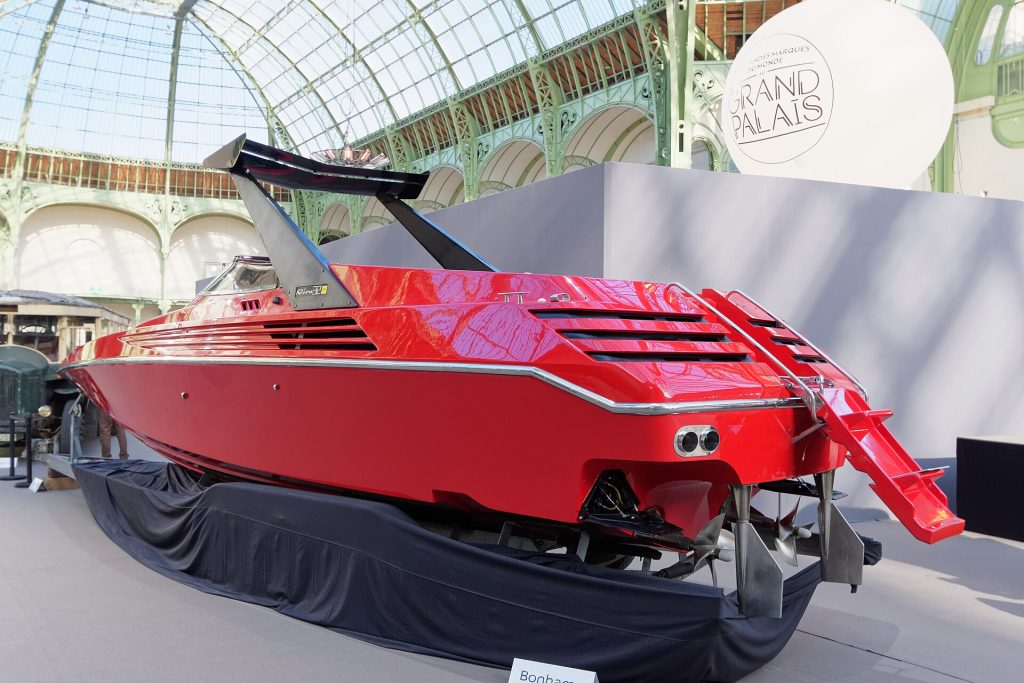
The existing featured-image credit belongs in the profile's lower image-credit panel. Attribution names the maker of the photograph and its licence; it does not establish that the pictured boat is the precise Ariston variant or year claimed. Verify the depicted subject before adding a specific hull caption. If an archival image is unavailable, a carefully labelled illustration is more honest than an unsupported identification.
A timeline for a specific hull
A practical Ariston history can be organized around delivery, early ownership, major repairs, engine changes, restoration and current survey. Put the source beside each event: invoice, registration, dated photograph, yard correspondence or owner recollection. Recollection can guide research, but should be labelled as such. A later registration date need not be the build date, and a modern title does not establish original equipment. The 1950 launch and 26-year model run are context for this individual chronology, not substitutes for it.
Where the chain has a gap, write the last documented date and the next documented date. A future archival discovery can then fill the interval without undoing invented detail. Keep old engine plates, removed fittings and restoration photographs when practical. Their value is evidentiary as well as sentimental: they make it easier for a specialist to assess how the boat changed during its life.
Comparing an Ariston with another Riva
A buyer may compare an Ariston with an Aquarama because both belong to the yard's wooden-runabout history. Compare documented hulls on the same basis: year, original configuration, present structure, restoration scope and provenance. The Aquarama's 1962 debut and final Special in 1996 do not describe the Ariston's production run. Nor does the Ariston's 1,012 count indicate how many Aquaramas were made. Names and dates should remain attached to their own models.
A visual comparison is useful for design appreciation, but a sale comparison requires evidence about condition and documentation. Two boats with equally glossy decks may differ substantially underneath. A well-kept original element and a meticulously replaced component both deserve accurate description. This approach lets collectors value craftsmanship without turning every restoration choice into a claim of factory originality.
A living reference page
The manufacturer's public record supports a concise set of durable facts: launch in 1950, 1,012 built across 26 years and a place among Riva's celebrated wooden boats. A future factory brochure for a particular year could add year-specific engine and dimension data. The article should then label the specification by year and compare it to individual hull records. It should never flatten decades of production into a single unqualified number.
Photo attribution should remain with the image credit, while the text explains what a pictured hull can be shown to represent. A corrected identification or better archive record should be incorporated transparently. Such updates strengthen a profile's usefulness for owners, researchers and prospective buyers long after a launch announcement or sales listing disappears.
Why this machine matters
Ferretti Group calls the Ariston an iconic Riva and gives a 1950 launch, a 26-year production span and 1,012 boats built. Its own Riva Classiche program underlines the significance of original details and appropriate restoration.
The story
The Ariston sits in the era when Riva’s wooden runabouts defined the yard’s craft identity. Ferretti Group identifies it as a model launched in 1950 and describes 1,012 built across 26 years. The company presented an Ariston alongside a Corsaro and Aquarama at a Riva Classiche exhibition, deliberately distinguishing the three models.
Built in limited numbers
Ferretti’s 1,012 count describes the complete Ariston run. Its 26-year span is reported without a hull-by-hull production list in the cited article; a specific boat’s build date and configuration should come from its records. This page does not extrapolate a surviving population or assume all examples used the same engine.
On the water
Riva Classiche describes preserving original detail and finishes in mahogany and fiberglass craft. On a wooden Ariston, the restoration record is therefore a central part of understanding the object. The linked source does not provide one universal horsepower, top speed or engine fitment, so those fields remain qualified.
Specifications
Factory specifications may vary by model year, market and configuration.
Identity & production
- Official model
- Riva Ariston
- Worldwide production
- 1012
Powertrain & performance
- Horsepower
- Not asserted as a model-wide constant
Marine specifications
- Category
- Classic wooden runabout
- Hull material
- Mahogany/wood
Authenticity & identification
Confirm the hull identity and consult Riva records for the original configuration. Restoration, replacement wood and installed machinery should be documented individually rather than inferred from the Ariston name.