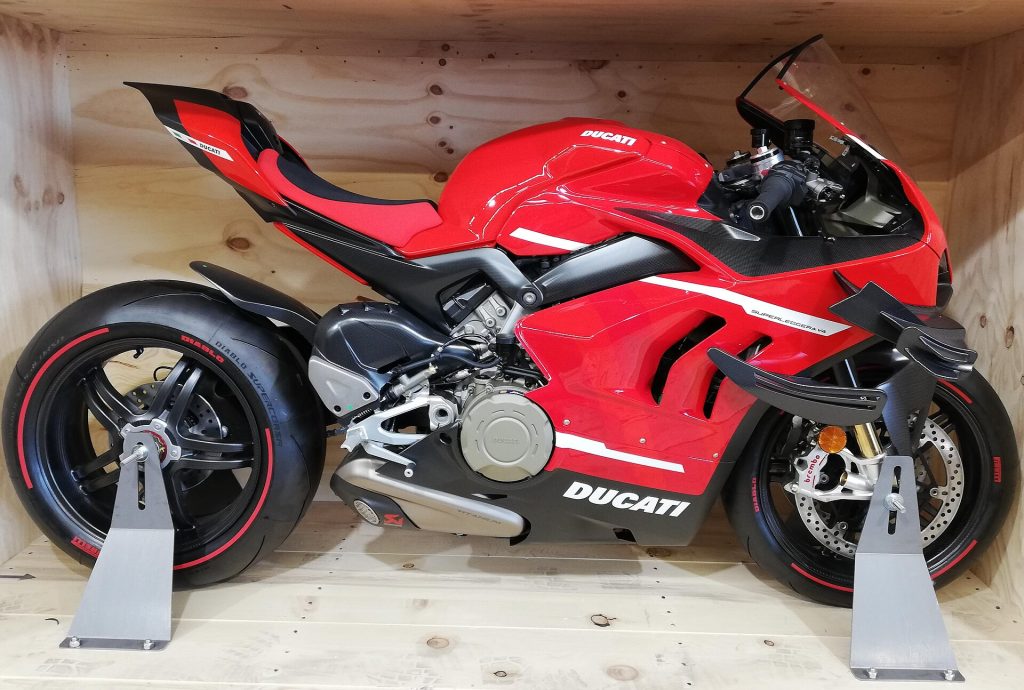
Ducati 1199 Superleggera
Ducati’s first Superleggera: 500 numbered bikes and a factory-stated 155 kg dry weight.
The Ducati 1199 Superleggera established a distinct high-end direction for Ducati's production superbikes in 2013. Based on the 1199 Panigale, it was designed to reduce mass as far as possible within the project. Ducati's heritage entry states that 500 numbered motorcycles were built, dry weight was 155 kg and maximum power exceeded 200 hp. Those are the figures supported by the cited factory retrospective. It does not provide a more exact output in that entry, so this profile does not promote an unattributed number to an official specification.
The name “Superleggera” now covers several separate Ducati editions. An 1199, a 1299 and a V4 Superleggera are different motorcycles, despite a shared philosophy of lightness. Their frames, engines, outputs and production statements should not be blended. A full model name is essential in a search title, photograph caption and sale description, especially when the searcher asks “How many Superleggeras were made?”
The first Superleggera project
Ducati says the 1199 Superleggera emerged from the 1199 Panigale platform with the goal of driving weight down and performance up. Its limited-series overview places the 2013 bike at the beginning of this particular lineage. That relationship to a production superbike is important, but “based on” does not mean the edition shares every structural component or delivered specification with a normal Panigale.
The 500-bike run made the engineering exercise available as an individually numbered collector model. Ducati characterizes its impact in enthusiastic language; the stable facts are the development period, parent platform, finite run, dry mass and broad power threshold. This page uses those facts as the manufacturer-level baseline and distinguishes them from an individual's current state.
A later Ducati Superleggera retrospective identifies the original 1199's magnesium-alloy frame, swingarm and wheels. That is especially useful because it prevents a frequent mix-up with the carbon-fibre frame, swingarm and rims of the much later Superleggera V4. “Lightweight construction” describes the family idea; the material choice tells us which bike is under discussion.
Magnesium architecture and materials
Ducati's later manufacturer history credits the 1199 with a magnesium-alloy frame, swinging arm and wheels. The structural choices are central to its identity, not just visual carbon-style detailing. The bike's material story should be described from Ducati's own account rather than inferred from a photograph. A component can be painted or finished in ways that conceal its substrate, and a modified motorcycle can retain a badge while no longer carrying every original part.
For a collector, material-specific construction raises precise questions about repairs and replacements. Obtain an itemized record of any accident work, specialist assessment of the actual structure and dated photographs or invoices for major components. A pristine-looking surface cannot prove that a wheel or swingarm has never been changed. A documented replacement should be described by date and specification, not hidden beneath the vague label “original condition.”
The 1199's engineering should not be explained using specifications from later carbon-framed editions. Ducati's V4 model page describes a different project. Linking to it can help readers understand the evolution, but copying its carbon chassis and 998 cc V4 data into an 1199 entry would be a serious factual error.
Engine output: what Ducati actually states
The Ducati heritage page says maximum power exceeded 200 hp. It does not give a more precise figure there. An exact output published elsewhere could depend on market, exhaust or a racing kit, so a source and configuration must travel with the number. “More than 200 hp” is less satisfying for a comparison chart but more accurate than pretending an unsupported precision is factory verified.
The 1199 designation relates to the Panigale generation and engine family, not the later 1299 or V4. A seller may describe upgrades or track equipment that alter the present configuration. Those are car-level claims requiring invoices and inspection. Factory historical data describe the original edition, while a dynamometer result or a tuned ECU describes a particular motorcycle under defined conditions.
An ownership record should also identify whether the motor remains in its delivered configuration and whether major internal work was carried out. The presence of a period-correct exterior is not evidence about internal components. A transparent service file can make a repaired or maintained bike easier to understand than an unsupported claim of untouched perfection.
Interpreting 155 kg dry
Ducati quotes 155 kg dry for the 1199 Superleggera. “Dry” is a defined manufacturer convention and should not be treated as wet, fuelled mass. An actual bike with fluids, fuel, accessories or different parts will weigh more or differently according to the scale and method. Comparing the Ducati dry figure with another maker's kerb figure creates a false performance comparison.
The quoted mass captures the whole design effort rather than the contribution of one wheel or panel. A collector should distinguish the original lightweight specification from a later machine that has acquired replacement exhaust, wheels or street accessories. If a seller claims an exact current mass, request its measurement basis and a description of installed equipment.
Power-to-weight claims require the same discipline. Using “over 200 hp” as though it were exactly 200 and mixing that with a dry weight to quote a precise ratio would manufacture accuracy Ducati did not provide in the cited heritage account. The most useful statement is simpler: Ducati documents a very low dry mass and an output beyond 200 hp for the original model.
The numbered run of 500
Ducati explicitly reports 500 numbered 1199 Superleggeras. This is an original model-run figure, not a survivor register or country-by-country allocation. The number belongs to the 1199, even though another Superleggera edition might also have a 500-unit limit. Identical totals across separate editions do not merge them into one production history.
A number plate can be photographed, but it should be matched to frame identification and original Ducati documents. If the component carrying it has been replaced or altered, the file should explain that history. A low serial or edition number does not automatically mean a motorcycle was the first completed, the first delivered or the best preserved. Each stronger claim needs its own evidence.
Production, order, delivery and first-registration dates can differ. Ducati's 2013 historical placement identifies the project period; it does not date every motorcycle. Use an individual bike's purchase and factory records for a precise chronology. A later registration year is not, by itself, proof that a bike belongs to a different Superleggera generation.
1199 versus 1299 and V4
The Superleggera name is a lineage of special projects, not a single mechanical specification. The 1199 was built from the 1199 Panigale foundation in 2013. Later Ducati editions used different base models and materials. Search engines often drop numerals, and a page titled simply “Ducati Superleggera specifications” can misdirect a reader. The full 1199 designation belongs in the H1 and SEO title.
The most consequential mix-up concerns materials. Ducati's later account describes magnesium-alloy structural parts on the original 1199, while the V4 page emphasizes carbon-fibre frame, swingarm and wheels. These are different material programs. Similarly, the V4's 998 cc, 224 hp road and 234 hp race-exhaust figures do not belong in this 1199 article.
Internal links should guide readers to the separate V4 profile with descriptive anchor text. A future 1299 entry should receive the same treatment. This is useful for SEO because a reader seeking a specific generation can find the exact answer, and it reduces the chance that a general search result blends specifications across eras.
Racing equipment and completeness
Special-edition sports motorcycles can be supplied with documentation and equipment that owners later separate from the bike. The exact original 1199 package must be established for the bike's market and invoice, not copied from a later Superleggera launch. Ask which original components, manuals, keys, documents and track-oriented parts are present, and itemize them with photographs.
If racing equipment is installed, distinguish it from the homologated delivered configuration. A modified exhaust, ECU or bodywork may change noise, emissions and power, and local road legality cannot be established from a global heritage article. Verify the current configuration and applicable jurisdiction. A seller's “complete” claim should refer to a dated inventory, not merely a clean photograph.
Equipment completeness is one dimension of collector interest, while present mechanical condition is another. A boxed component does not prove the installed parts are sound. Conversely, a missing accessory does not erase the model's factory identity. Describe both accurately and let a buyer evaluate their significance.
Documentation and authenticity
Begin with frame and engine identity, edition number and Ducati's factory paperwork for the individual motorcycle. Assemble invoices, registration, ownership and service records chronologically. Identify changes to structure, bodywork, wheels, engine or electronics, and seek dated supporting evidence. A generic model history cannot certify the private bike in a listing.
Photographs are most useful when dated and linked to a particular identification. They can show appearance before and after repair or use, but not hidden structural condition. An auction description may help locate earlier ownership, but should be checked against more direct records. If two documents disagree, retain both and note the unresolved question rather than silently choosing the flattering version.
A specialist inspection should focus on the actual machine. Material condition, mechanical operation, service history and current software or electronics cannot be inferred from an edition plate. The more exceptional the claim—unused, no track history, all-original components—the more specific the evidence should be.
Ownership and preservation
Build an evidence table for a specific bike
A useful ownership review separates claims into “factory model,” “delivered example” and “present condition.” The 500-unit run and 155 kg dry weight are factory model facts from Ducati. A red-and-white livery, a particular numbered plate, an invoice date and original accessories belong to the delivered example and need the bike's documentation. A specialist's observation about a wheel, frame or engine belongs to present condition and needs a date. This simple separation prevents a factory press statement from being used to certify an individual motorcycle.
For each claim, record the exact source, date, identification and any unresolved conflict. If a frame record and a seller's number plate description differ, do not infer a harmless typo without checking Ducati. If a service invoice lists a replacement wheel, connect it to photographs and the part actually installed. The method may sound methodical for a motorcycle, but the original material programme and finite run justify that care.
Understanding original, restored and modified
These words are often used as if they were mutually exclusive grades, yet they describe different facts. “Original” may refer to paint, frame, engine, wheels or simply the model designation. “Restored” needs a scope of work and dates. “Modified” can range from a reversible accessory to a major mechanical change. Ask a seller to define each term against an itemized component list. A documented change can be evaluated; an unsupported adjective cannot.
When a bike has both original and replacement components, state that precisely. Do not label the complete machine “matching” unless the manufacturer documentation and applicable identification support the defined claim. Equally, a correct replacement part should not be passed off as the one installed at delivery. Clear language helps future owners, insurers and researchers maintain the same history rather than rediscover a missing fact after each sale.
Why the model is more than a production number
Limited editions exist at many levels. The 1199 combines the numbered 500-bike run with a defined weight-reduction objective and a material programme Ducati later singled out in its own history. These points explain why it belongs in an encyclopedia of rare vehicles. The finite run alone would be a weaker story without the engineering choices. A collector evaluating two bikes should therefore examine both their model-correct components and their individual histories.
The same principle limits unsupported superlatives. Ducati's retrospective positions the bike as a technical and commercial success; that is useful historical context. Whether it is a better purchase than a 1299 or V4 depends on the reader's criteria and the particular examples. This profile documents the 1199's place in the lineage and does not turn a manufacturer celebration into a ranking of modern investment prospects.
A low-mileage collector bike can still have age-related service needs, while a used bike may have a strong, documented maintenance record. Evaluate actual history and current condition rather than assigning virtue or risk to an odometer number alone. Obtain Ducati guidance applicable to the frame number, market and configuration. The heritage page is a historical source, not a current service schedule.
Track use should be documented without automatic judgment. The 1199 is a performance motorcycle; event logs, service invoices and setup sheets can provide valuable context. Absence of such records does not prove no use, and visible wear needs an informed assessment rather than a blanket conclusion. A collector file should state what is known and what remains unverified.
Market values and future returns vary with time and individual condition. This encyclopedia profile does not present a price forecast. It establishes the manufacturer-supported run, mass and broad engine output, then explains the evidence needed to assess a particular example.
Frequently asked questions
How many Ducati 1199 Superleggeras were built?
Ducati says 500 individually numbered examples. The number describes the original 1199 edition, not a current survivor count or the entire Superleggera lineage.
What does it weigh?
Ducati quotes 155 kg dry. This is not a wet or ready-to-ride mass and should not be compared unqualified with a rival's kerb weight.
How much power does it have?
The cited Ducati heritage account says maximum power exceeded 200 hp. This profile does not assign a more exact manufacturer figure without a directly supporting source and configuration.
Is the 1199 built with a carbon-fibre frame?
Ducati's later history describes magnesium-alloy frame, swingarm and wheels on the original 1199. Carbon-fibre frame, swingarm and wheels are a defining claim for the later V4 Superleggera, a different model.
Is a numbered plate enough to authenticate one?
No. Reconcile it with the frame identification, Ducati documents and the bike's ownership and service history. The plate establishes a clue to investigate, not the condition or identity of every component.
Can a later V4 specification be used for the 1199?
No. The engines, materials and published performance belong to separate generations. Use generation-specific Ducati sources.
Sources and scope
The original 1199's story is unusually vulnerable to specification drift because later Ducati launches reused the Superleggera name and sometimes the same 500-unit number. Every future update to this page should start by checking that a source names the 1199 specifically. A correct manufacturer page for a different generation is still the wrong source for this motorcycle.
The Ducati 1199 heritage profile supports the 2013 history, 500 total, 155 kg dry weight and broad power claim. Ducati's limited-series archive situates it in the family. Its later Superleggera retrospective identifies the original magnesium architecture, while the V4 page illustrates why the generations must be separated. None of these sources authenticates a specific private motorcycle.
Keeping the first Superleggera distinct
Ducati's later limited-series history is useful for understanding the 1199's place in a lineage, but specifications from a later Superleggera should not migrate backward into this model. In particular, the materials and mechanical features of a V4-era machine are not automatically those of the 2013 1199. Date each claim and attach it to the exact model named by Ducati. For an individual motorcycle, check its numbered identity, original equipment and records of replacement parts before describing it as an untouched example of the 500-unit run.
Why this machine matters
Ducati describes the 1199 Superleggera as a 2013 effort to reduce weight as far as possible on an 1199 Panigale base. The manufacturer reports 500 numbered motorcycles, more than 200 hp and a 155 kg dry weight.
The story
The 1199 Superleggera established Ducati’s Superleggera line in 2013. Ducati’s heritage page explains the goal in direct terms: take the 1199 Panigale foundation and reduce mass to lift performance. The manufacturer cites lightweight materials and a dry weight of 155 kg. It describes engine output as exceeding 200 hp rather than giving an exact number on that page.
Built in limited numbers
Ducati explicitly says 500 numbered examples were built. That is a model production figure, not a claim about remaining motorcycles or the number in any specific country. Superleggera is also a name shared by later editions, making the 1199 designation essential in search titles and identification.
On the road
A dry weight omits operating fluids under the manufacturer’s measurement convention. The cited 155 kg should therefore not be compared directly with a wet-weight number for another motorcycle. Ducati’s historical “more than 200 hp” statement is deliberately retained as a threshold instead of inventing a precise output.
Specifications
Factory specifications may vary by model year, market and configuration.
Identity & production
- Official model
- Ducati 1199 Superleggera
- Base model
- 1199 Panigale
- Edition
- Superleggera
- Worldwide production
- 500
Powertrain & performance
- Horsepower
- More than 200 hp (Ducati historical account)
Motorcycle specifications
- Category
- Limited-production superbike
- Dry weight
- 155
Authenticity & identification
Use the numbered bike’s factory records, identification and original equipment list. Ducati’s model history identifies the edition, but it cannot verify a specific machine’s mileage, service work or whether components have been replaced.