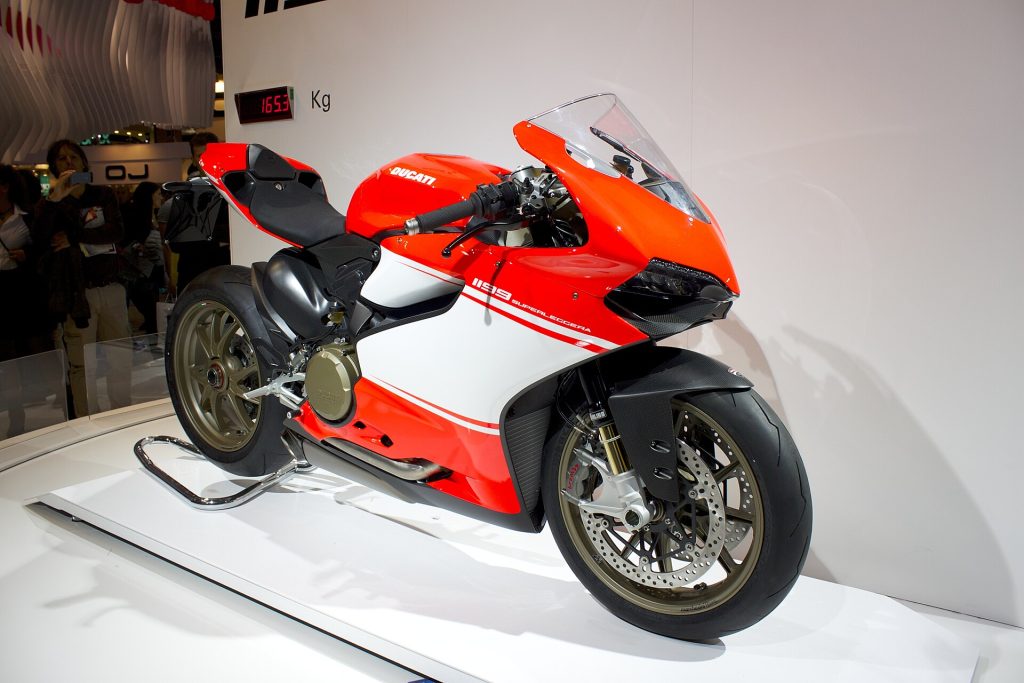
Ducati Superleggera V4
A numbered 500-bike run built around carbon-fiber chassis components.
The Ducati Superleggera V4 is a numbered, 500-unit motorcycle built around an unusually ambitious use of carbon fibre. Ducati identifies a carbon-fibre frame, swingarm and wheels on a road-approved machine, alongside a 998 cc V4 and a separate racing-kit configuration. Those details make the edition more than a paint treatment. They also make precision essential: the street and track figures differ, “dry weight” is not ready-to-ride mass, and an edition number does not authenticate a particular motorcycle on its own. This profile uses Ducati’s model specification and production announcement as its baseline.
The Superleggera name has appeared on more than one Ducati. This is the V4, not the earlier 1199 Superleggera or the later V4 Centenario. A search result or seller description that drops the suffix can combine different production runs, materials and outputs. The exact model name, year, configuration and numbered plate should accompany any substantive claim.
Why Ducati developed the V4 edition
Ducati presents the Superleggera V4 as an exercise in reducing weight and applying sophisticated materials to a homologated sports motorcycle. Its launch account explains the relationship to the Panigale V4 while identifying a different 998 cc engine, carbon structure and dedicated aerodynamic treatment. The edition is best understood as an integrated project: a frame material, swinging arm, wheels, bodywork, powertrain and electronics selected together. A single “limited edition” badge would not tell that engineering story.
The model also demonstrates the difference between a public-road configuration and an owner’s track equipment. Ducati supplied a racing kit and published separate figures for it. That choice is central to how the motorcycle is discussed, because a headline claiming 234 hp or 152.2 kg without context can mislead readers about the homologated road bike. A careful profile states the configuration beside the number every time.
Development language in manufacturer material can be promotional. Our role is to extract what can be checked: the specified materials, displacement, stated outputs, weights and production limit. Descriptions such as “most advanced” or “unmatched” are Ducati’s positioning rather than an independent comparative test of every competing motorcycle. The verified engineering is compelling without converting advertising language into universal fact.
The 998 cc Desmosedici Stradale V4
Ducati’s technical table describes a liquid-cooled 90-degree Desmosedici Stradale V4 with a counter-rotating crankshaft, desmodromic valve timing and 998 cc displacement. It lists 165 kW or 224 hp at 15,250 rpm in the road configuration and 174 kW or 234 hp at 15,500 rpm with the full racing exhaust. The torque figures likewise differ: 116 Nm in the standard listing and 119 Nm in the racing configuration. A reader should not combine the road weight with a racing output or assume both sets of figures apply simultaneously to a bike photographed with street equipment.
The smaller displacement compared with the 1,103 cc Panigale V4 is a real distinction, not a typographical error. Ducati says the 998 cc unit weighs 2.8 kg less than the larger V4 in its launch discussion. That is a comparison of specified engine versions, not proof that any particular privately owned bike retains its original internals or exhaust. A collector file should document modifications and show whether the supplied racing hardware remains with the machine.
The high quoted engine-speed points tell a technical story about the intended application. They do not tell how an individual engine was used or maintained. Mileage, track use, storage and service history need actual records. Claims about “never raced” or “only displayed” are provenance assertions; a production brochure cannot validate them.
Carbon-fibre structure, swingarm and wheels
Ducati emphasizes that the Superleggera V4 was road approved with a carbon-fibre frame, swingarm and rims. Its model sheet also identifies carbon fairings, mudguards and biplane wings. Carbon here is part of the structural and aerodynamic programme, not merely a surface texture. The materials make the motorcycle distinctive within the manufacturer’s history and explain why inspecting a specific machine requires more than a quick cosmetic walkaround.
Carbon-fibre construction also makes originality and repair questions more precise. Obtain a specialist assessment of any disclosed impact, replacement or repair. Ask for dated photographs and invoices showing what was done and by whom. A clean exterior photograph cannot prove that a hidden structural component was never repaired. Conversely, a documented manufacturer-approved replacement should be described factually rather than treated as a mystery. This is a method for evaluating a particular bike, not a claim that the model has a recurring defect.
The factory’s material claims are model-level. If an individual motorcycle has aftermarket wheels or body panels, the configuration differs from the original specification even if the edition plate remains genuine. List original parts retained with the sale, their condition and any substitutions. For a limited-run motorcycle, that inventory can matter as much as a photograph of the numbered plaque.
What “159 kg dry” actually means
Ducati quotes 159 kg dry for the road configuration and 152.2 kg with the racing kit. Dry weight excludes operating fluids under the manufacturer’s stated convention; it is not a measured wet, fuelled mass. Comparing these values with a competitor’s kerb or wet weight without adjusting definitions is misleading. The stated difference between the two Ducati configurations also does not mean every owner’s installed race kit will weigh precisely that amount under every measurement method.
Weight reduction comes from a collection of choices rather than one magic component. Ducati describes carbon, titanium, magnesium and machined aluminium parts. The launch material contrasts the Superleggera V4’s dry weight with that of the Panigale V4. That comparison is useful when the same source and basis are retained; it should not be expanded into an independent ranking of all contemporary superbikes.
For a collector, a scale reading on a privately owned bike may differ because of tyres, exhaust, equipment, fluids or modifications. Document the exact configuration before comparing it with Ducati’s published number. The same principle applies to power-to-weight ratios: they are meaningful only when the power and weight correspond to the same version and measurement convention.
Aerodynamics and electronics
The Superleggera V4’s biplane wings are a visible part of Ducati’s aerodynamic concept. They distinguish it from a generic faired sportbike, but a photograph alone does not establish the precise aerodynamic effect on a given bike. Manufacturer claims should be reported with their stated speed and configuration where available; a simple statement that wings “add downforce” does not replace a measured test or a component inspection.
Ducati’s equipment list includes riding and power modes, cornering ABS, traction control, wheelie control, slide control, engine-brake control and automatic tyre calibration. The presence of electronics is a factory specification, while their current software status and operation on a particular motorcycle require a diagnostic review. A seller’s assertion that every system functions properly deserves verification rather than repetition.
The six-speed gearbox and Ducati Quick Shift system belong in the mechanical overview as well. These features help explain why the bike was conceived as a high-performance whole. They do not justify a universal claim that every owner will experience the same handling, braking or track pace. Tyres, setup, rider skill and condition affect those outcomes.
The 500-bike production run
Ducati announced a limited, individually numbered series of 500 Superleggera V4 motorcycles and described a certificate of authenticity accompanying them. The number is a manufacturer edition limit. It does not identify how many were delivered in a particular country, how many survive, or which are still in original street configuration. A plaque reading “001/500” is a useful identifier, but it should be reconciled with Ducati’s records and the motorcycle’s own identification documents.
Production and delivery are separate events. Ducati publicly described the first bike leaving its Borgo Panigale plant and later the delivery of number 001. Those milestones do not establish a manufacturing sequence for every subsequent motorcycle. A seller’s claimed delivery date, market or first owner should be supported by its own invoice and registration history.
Edition numbers often attract search interest because they appear to offer instant rarity within rarity. The truth is more nuanced. Number 001 has a documented manufacturer story; other numbers require their own evidence if a special status is claimed. A low number alone does not demonstrate a superior mechanical condition or a unique factory specification.
Racing kit and equipment completeness
Ducati describes a racing kit that includes the titanium exhaust and other track-oriented parts. The model specification lists dedicated equipment such as stands, battery maintainer, cover and data-related hardware in some market presentations. Equipment can vary by region and over time, so the buyer should reconcile the original invoice and market specification with the items physically present. Do not promise that a privately offered bike comes with everything pictured in a manufacturer launch photograph.
The racing exhaust changes the published power figure. Track-only equipment also raises a distinct question from ownership of the homologated street machine: which components are installed now, which original road parts remain and what configuration is legal for the intended jurisdiction? A global encyclopedia page cannot determine local registration compliance. It can insist that the two configurations be named correctly.
Keep an itemized record of original and supplied parts with photographs and serial information where relevant. A missing crate, certificate or accessory should be noted accurately. It may affect a buyer’s appraisal of completeness, but this profile does not attach a universal monetary adjustment to any one item.
Authenticity and provenance
Documenting the edition without overclaiming
A useful catalogue description separates four layers of evidence. First is the edition as announced by Ducati: a 500-bike numbered run. Second is the factory identity of a particular motorcycle, demonstrated through its records. Third is present configuration, including whether road or racing exhaust and other equipment are fitted. Fourth is condition and history, which change over time. A statement can be correct at one layer and still say nothing about another. For example, an authentic numbered motorcycle may have replacement bodywork, while a low-mileage example may have an incomplete accessory set. Neither fact changes the published edition limit.
This layered approach also helps with photographs. A picture of the plaque can record the displayed number, but does not prove that the rest of the machine corresponds to the factory record. An image of a race exhaust can identify a visible configuration, but cannot prove the engine produces Ducati’s quoted output. Attach dates and the vehicle identity to images used in a provenance file. If the images predate a restoration or a component change, state that explicitly.
Collectors may encounter terms such as “investment grade,” “never started” or “new in crate.” These are not factory specifications. They describe a seller’s account of a particular machine and need their own evidence and precise definitions. A motorcycle displayed for years still requires an examination of its mechanical and electrical condition before use. The documented rarity of the model should encourage careful verification, not substitute for it.
Start with the vehicle identification and Ducati’s edition documentation. Match the numbered plate, certificate, sale paperwork and the bike’s actual configuration. Construct a dated chain of ownership and service. Ask for invoices for major repairs, replacements or race-kit installation and removal. If a bike has been displayed or used at events, support that history with dated records rather than an unattributed story.
The certificate is valuable evidence of the edition, but it cannot prove present condition. A specialist should inspect the carbon structure, wheels, bodywork, powertrain and electronics on the particular example. Records should distinguish original factory items, genuine replacement parts and aftermarket equipment. If claims conflict, preserve the discrepancy until the source can be resolved.
Photographs establish appearance at a point in time. They can help document changes to livery, fairings or exhaust, especially when dated and tied to the same identification. They do not reveal every internal or structural condition. The strongest collector file combines factory identity, coherent paperwork, direct inspection and a transparent explanation of changes.
Ownership considerations
How to read competing specification summaries
A short search snippet may call the bike a “224-hp, 159-kg” machine, while another calls it “234-hp, 152.2-kg.” Both can derive from Ducati, but they refer to different states of equipment. When compiling a collector record, make a simple two-column comparison of street and racing-kit configurations and retain the manufacturer’s units and definitions. The exhaust, associated parts and the condition of the original equipment should be photographed on the actual bike. Avoid presenting a theoretical best combination assembled from unrelated figures as if Ducati published it as one road-legal specification.
The same care applies to other markets. A manufacturer's global launch story, a Canadian model page and an individual invoice may describe different regulatory or included-equipment details. If they disagree, identify the market and date of each source, then state what can be verified for that exact machine. This is especially useful when a motorcycle crosses borders or has its track kit installed later. An encyclopedia page can explain the factory project; the bike's documents establish its delivered specification.
Confirm the applicable Ducati service guidance for the vehicle identification number and its actual mileage and use. The model page lists a valve-clearance interval, but that specification should not be treated as a complete maintenance plan or a guarantee that all work was performed. Ask for dated service records and verify current consumables. A very low-mileage machine may still need a condition assessment after storage.
If the motorcycle was used on a track, assess it as the actual example rather than assuming track use is either automatically damaging or irrelevant. Record its configuration, inspect components and review maintenance. If it is represented as never used, the claim should be documented where possible. The goal is a candid description, not a moral judgement about whether a high-performance motorcycle was ridden.
Prices and future returns are deliberately outside this permanent model profile. The edition count and construction are stable historical facts; market valuation is time-sensitive and specific to condition and provenance. Readers seeking a transaction decision should obtain current, local professional advice and inspection.
Frequently asked questions
How many Ducati Superleggera V4 motorcycles were made?
Ducati specifies a numbered series of 500. That is the original edition limit, not a verified survivor count or a national allocation figure.
Is the Superleggera V4 road legal?
Ducati describes the production configuration as approved for road use with carbon-fibre frame, swingarm and wheels. Legality of a specific bike, especially with race equipment installed, depends on its present configuration and jurisdiction.
Does it have 224 or 234 hp?
Both appear in Ducati’s specifications for different setups: 224 hp in the stated road configuration and 234 hp with the full racing exhaust. Quote the configuration with the number.
Does it weigh 152.2 kg?
Ducati lists 152.2 kg dry with the racing kit and 159 kg dry in the standard configuration. Neither is a wet, ready-to-ride measurement.
Is this the same as the 1199 Superleggera?
No. The 1199 and the Superleggera V4 are separate Ducati models from different periods with different engines and technical specifications. Their production and performance figures must not be combined.
What should an owner retain?
The edition certificate, purchase and delivery paperwork, service history, records of installed or removed equipment, and supplied original parts all help document a specific bike. Confirm the exact factory package for its market and invoice.
Sources and scope
The Ducati Superleggera V4 technical page, Ducati launch account, production announcement and first-delivery account support the model facts. Statements about a particular motorcycle require its own documents and inspection.
Why this machine matters
The Superleggera V4 takes Ducati’s weight-saving program beyond bodywork. Ducati identifies carbon fiber in the frame, swingarm and wheels, an unusual collection of structural components in a production road motorcycle.
The story
Ducati’s published specification lists a 998 cc V4 and 224 hp in road form. The racing kit changes the stated output to 234 hp; the two figures should never be merged into a single stock specification.
Built in limited numbers
The company’s production announcement confirms 500 numbered bikes. The number is a factory limit, not a register of intact bikes or a count of deliveries to any one country.
On the road
Ducati quotes a 159 kg dry weight in its Canadian model material and 152.2 kg in racing-kit form. Dry weight is a defined factory measure and should not be read as fueled, ready-to-ride weight.
Specifications
Factory specifications may vary by model year, market and configuration.
Identity & production
- Official model
- Ducati Superleggera V4
- Worldwide production
- 500
Powertrain & performance
- Engine
- 998 cc Desmosedici Stradale R V4
- Horsepower
- 224 hp (road configuration)
Motorcycle specifications
- Category
- Limited-production superbike
- Dry weight
- 159
Authenticity & identification
Check the numbered identification and supplied factory materials for the actual motorcycle. Confirm whether any racing-kit components are fitted before comparing power and weight claims.