2021 Hyundai Heritage Series Grandeur EV
Hyundai Heritage Series Grandeur EV: the 2021 electric reinterpretation of 1986 luxury, cabin design, verified identity and credited photography.
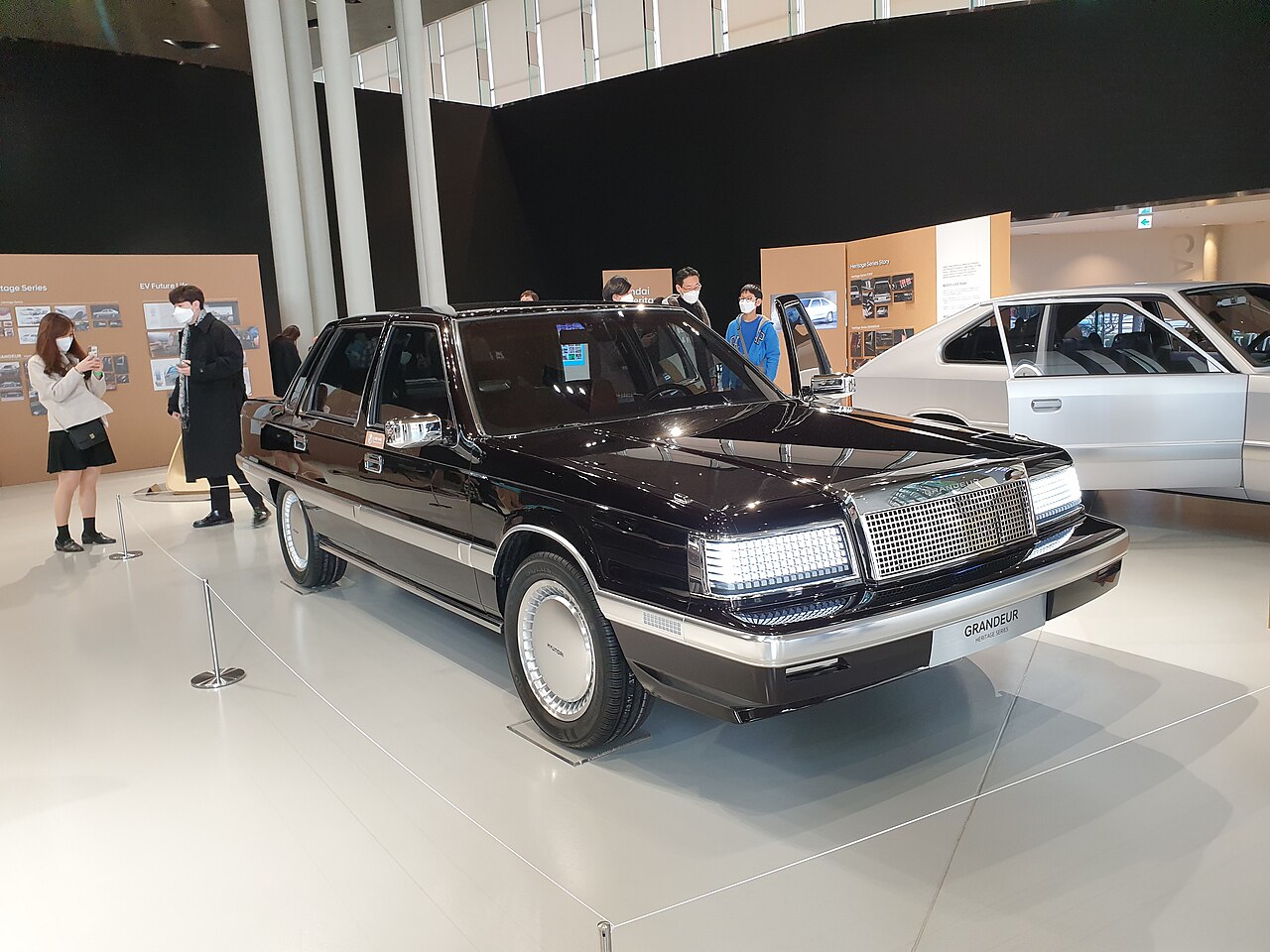
The 2021 Hyundai Heritage Series Grandeur EV reworks the upright luxury of the first Grandeur as a modern electric design statement. The angular sedan, pixel lighting and reimagined cabin create a heritage object with a distinctly contemporary interior brief.
Origins and the correct historical identity
Hyundai introduced the Heritage Series Grandeur in 2021 to mark 35 years since the original Grandeur’s 1986 arrival. The manufacturer describes an electric reinterpretation, with pixel-style lamps and a cabin combining red velvet, Nappa leather and a sound system developed with Guk-il Yu. These details belong to the modern project. They should not be presented as original equipment fitted to ordinary 1986 Grandeur production cars.
Design: what makes Heritage Series Grandeur EV distinctive
The exterior photograph shows why the old shape is an effective canvas. A long, straight body and formal glasshouse give the sedan an orderly presence. The modern lighting can then act as a concentrated visual signal rather than a reason to redraw every panel. As an interpretation, this approach treats heritage as a set of proportions and relationships that can accommodate a different technology. The car’s upright stance also offers an alternative to the assumption that an electric design must communicate modernity through sweeping curves alone.
Engineering and the concept brief
The concept’s electric identity is verified, while exact motor output and usable battery capacity remain unspecified here. Interior presentation is a better documented part of the programme. The cabin’s combination of material, lighting and sound is useful to study as a complete environment, rather than reducing luxury to a power figure. A future engineering record should distinguish the installed conversion hardware from specifications of contemporary Hyundai production EVs, since a shared manufacturer does not establish a shared platform.
Why this Hyundai belongs in the design archive
The Grandeur belongs in a heritage archive because it demonstrates how a flagship’s visual status can be reinterpreted. The older sedan supplies a sense of formality; the newer cabin asks what a lounge-like car might communicate through light, texture and acoustics. That combination is a curatorial opportunity. Displaying photographs of the exterior and interior together would show that the programme’s ambition extends beyond replacement headlights, while maintaining a clear boundary around the particular 2021 concept.
Recognising and documenting the physical subject
The supplied photo shows the black Grandeur Heritage Series EV at Motorstudio Goyang in November 2021. Its formal body and pixel lamps match the manufacturer’s programme imagery. It should be captioned as the modern Heritage Series concept whenever it is reused. The donor era remains part of the history, but the archive title uses 2021 so a visitor can distinguish this vehicle from a first-generation production sedan. Interior details require their own photographs; the exterior view alone does not verify individual cabin components.
Reading an electric concept powertrain
An electric concept can answer a design question without publishing the engineering dossier of a customer vehicle. Motor power, usable battery capacity, charging limits and cooling strategy describe different parts of that dossier. A photograph of the completed body establishes its physical design, while the manufacturer’s programme description establishes the intended propulsion. Neither supplies the missing numerical fields. For this car, the profile keeps those two forms of evidence together while reserving precise performance figures for an original, correctly scoped technical record. That makes the history useful even when a later electric model carries a similar visual signature.
For an archive vehicle, electrification also changes how the cabin can be interpreted. Removing the need to celebrate an engine does not remove the need for a focal point: lighting, instruments, seating and the approach to controls become part of the attraction. The relevant question is how this particular design expresses its electric identity. A collector can record those choices through dated exterior and cabin photographs, then compare them with the manufacturer’s original presentation. That is a richer account than attaching the range or battery specification of an unrelated modern EV.
Collector significance and future research
The value of a concept archive lies in preserving the relationship between an idea, the people who developed it and the object that made it visible. A strong collection record keeps the original name, reference year, credited photographs and source links attached to that relationship. If new photographs or factory documents emerge, they can add a show appearance, a construction detail or a later change without replacing the original identity. This is particularly useful for a car whose published pictures may span several exhibitions and whose name may have acquired different spellings.
The complete fabrication tally remains unknown here. Exhibition appearances do not provide a count: the same object can travel, and a programme may also produce models or development articles that are not visible publicly. The concept belongs in this archive because its physical identity is supported, rather than because a single surviving photograph implies that only one was made. A future tally should identify which objects it covers and the document establishing that scope. Until then, this profile provides the historical and photographic foundation for further documentation.
Reading the evidence for this profile
The original source links below identify the programme and the historical statements used in this article. The photograph has its own creator and licence record, separate from the manufacturer’s vehicle history. Keep both when transferring this profile into a collection catalogue. A manufacturing tally describes how many cars belong to a defined original programme; it does not measure how many survive, how many are publicly visible, or how many retain all their original components. Those individual questions require dated chassis and restoration evidence. The reference year likewise describes the programme’s introduction or named historic configuration, while the supplied caption states the photographed setting and any established individual identity. This lets future research expand the car’s history without blurring the scope of the record already assembled here.
Specifications and verified rarity
| Reference year | 2021 |
|---|---|
| Model / programme | Heritage Series Grandeur EV |
| Body / role | Electric heritage sedan concept |
| Original heritage reference | First-generation Grandeur, introduced 1986 |
| Modern programme | Heritage Series EV, 2021 |
| Installed motor / battery rating | Not established |
| Cabin brief | Reinterpreted luxury, lighting, materials and sound |
| Exact manufacturing tally | Not established |
| Rarity evidence | Physical concept archive scope; tally unknown |
| Rarity scope | Verified physical Heritage Series EV concept; complete fabrication tally unconfirmed. Included as Concept / Archive, without an invented one-car count or retail-production ceiling. |
| Inventory reference | HYU-017 — Verified |
Frequently asked questions
Why does the title use 2021 rather than 1986?
2021 dates the Heritage Series EV programme; 1986 dates the original Grandeur inspiration.
Is this a standard first-generation Grandeur?
It is Hyundai’s electric heritage concept, with a reimagined exterior detail and cabin.
Does the profile establish a production run?
No complete fabrication tally or customer-edition ceiling is established.
Are modern Grandeur specifications applicable?
Specifications from later production Grandeurs are not assigned to this concept.
What rarity or archive scope is verified?
Verified physical Heritage Series EV concept; complete fabrication tally unconfirmed. Included as Concept / Archive, without an invented one-car count or retail-production ceiling.
Who took the supplied photograph?
Damian B Oh via Wikimedia Commons, under CC BY-SA 4.0. The original file and licence links accompany the image. Retain that credit when the photograph is uploaded, exported or reused.
Related Hyundai concept profiles
Sources and photo credits
Photograph: Damian B Oh via Wikimedia Commons original file, CC BY-SA 4.0. Source-provided photograph supplied without local cropping, retouching or text removal. A source thumbnail is used where available. Hyundai Heritage Series Grandeur EV at Motorstudio Goyang, November 2021; the photo shows the modern electric heritage concept.
Built in limited numbers
Verified physical Heritage Series EV concept; complete fabrication tally unconfirmed. Included as Concept / Archive, without an invented one-car count or retail-production ceiling.
Gallery
Specifications
Factory specifications may vary by model year, market and configuration.
Identity & production
- Official model
- Heritage Series Grandeur EV